
I present the results here for those interested in undertaking this (or a similar) conversion.
The first task is to calculate the pressure to which the Rotrex will boost the plenum chamber (at wide open throttle or WOT) for any given value of mass-air-flow through the engine. From the ideal gas law, and the fact that an engine inducts a constant volume (not mass) of air on each intake stroke, it can be shown that:

Where:
- Pm is the manifold absolute pressure or MAP (in pascals),
dma/dt is the air flow through the engine (in kg/second)
R is the universal gas constant (8.3144 Joule/kelvin.mol),
Tm is the temperature of the air inducted into the engine (in kelvins),
F is the mass-ratio of fuel to air (typically around 1/15 to 1/12),
Vd is the displacement of the engine (in cubic metres),
N is the rotational speed of the crank (in rotations/second),
na is the molar mass of air (0.029 kg/mol), and

is the volumetric efficiency of the engine (as a function of N).
Unfortunately, due to the adiabatic heating of the air passing through the supercharger (this is what happens when you compress a gas) the temperature Tm of the air being inducted into the engine is a function of pressure. Assuming an intercooler is included to cool the air coming out of the supercharger then, from first principles it can be shown that:

Where:
- Ta is the ambient air temperature, assumed to be 293 kelvin (20'C) in this case,
eic is the efficiency of the intercooler (typically around 0.7 for a standard unit),
P2 is the absolute pressure of the air at the Rotrex outlet (in pascals), and
P1 is the absolute pressure of the air at the Rotrex inlet, assumed 100kPa (at sea level) in this case.
Putting these three equations together we get:

Where dP is the pressure drop across the intercooler. I'll assume 7kpa in this case (1.0 psi), which will suffice for this analysis.
Now, we use this equation to determine P2 (the pressure at the supercharger outlet). Problem is, P2 features on both sides of the equation and it cannot be rearranged to solve for P2 uniquely. This is because it is a transcendental equation. In order to solve it I had to write an iterative routine in MATLAB. Bummer, you can't use a simple calculator, sorry!
The graph below shows a number of blue lines plotted on top of the Rotrex C30-94 compressor map. Each blue line is a solution to the above equation as a function of airflow (in kg/s) through the engine at a specific engine speed, where the engine speed relates to the compressor speed by the ratio of the pulley wheel diameters, and the internal gearing of the supercharger. A point is marked on the graph (in red) where each blue engine line intersects a black compressor line of the same RPM value. Joining these points establishes the loadline (in red) that defines the operation of this engine with the Rotrex C30-94 supercharger.
In this case a 140mm diameter pulley is assumed fitted to the crank, and a 100mm pulley fitted to the Rotrex. Thus, the supercharger pulley spins 1.4 times faster than the crank). This is exactly what Appletree has on his 318i at present.

What the above graph tells us is that, below a compressor speed of 65000RPM (~4900 engine RPM) the loadline is to the left of the compressor surge line. Thus, below 4900RPM engine speed, the air flow around the compressor blades is turbulent and will eventually fatigue the compressor blades to destruction. This turbulence comes about as a result of the fact that the airflow across the blades is too slow to sustain the pressure ratio (P2/P1) demanded in this area of the graph.
This problem typically occurs when the selected supercharger is too large for the fitted application. That is to say, it is intended to flow a greater mass of air at these lower pressures, as would be the case on a larger capacity engine. Ideally, the plotted loadline should be located further to the right of the compressor map, not only to keep the compressor from surging, but so that the loadline passes through the most efficient operating area of the supercharger.
We can calculate the theoretical power output of the engine using the following equation:

Where:
- W is the work performed by the engine (in Joules), and
bsfc is the weight of fuel required to liberate 1Joule of mechanical energy.
Thus, if W is the work done by the engine, then dW/dt is the rate at which the work is done, known to you and I as the Power Output of the engine (in Watts).
The loadline plotted on the Rotrax compressor map indicates that at 70000 compressor RPM (5300 engine RPM) around 0.14kg/s second of air flows through the supercharger at a pressure ratio of about 1.7. Taking into account the 7kPa drop over the intercooler, this equates to 63kPa (9psi) boost at the plenum chamber. Looking at the attached dyno graph, supplied by Appletree, we see a measured boost figure of 8psi at around 5200RPM, a discrepancy of only 1.0psi, but a discrepancy none the less, probably due to
- (a) a greater pressure drop across the intercooler than assumed,
(b) a 1psi pressure drop across the air filter and intake pipes (quite likely), or
(c) a different atmospheric pressure than I have assumed here (I have no idea what the barometric pressure was on the day of the dyno test).


The maximum recommended compressor speed of the Rotrex C30-94 is 100000RPM. With these pulleys this corresponds to around 7500 engine RPM, at which point the above graph indicates that the Rotrex is flowing roughly 0.25kg/s of air to the engine. This equates to an output power of 250kW, or 335hp. Unless the volumetric efficiency of the engine is markedly below that calculated, and provided the internals of the engine are sufficiently strong to handle this, I would expect that 335hp (at the flywheel) is quite likely. The trend indicated in the dynograph certainly indicates that this is possible. The trend of the graph, of course, says nothing about the condition or strength of the engine.
It is interesting to note that if one does not take into account a drop in the volumetric efficiency of the engine above ~7000RPM, the predictions will indicate abnormally high power outputs, that can not be achieved in reality!
More to come ....





 my calculations yeild similar results but im sure im missing something.

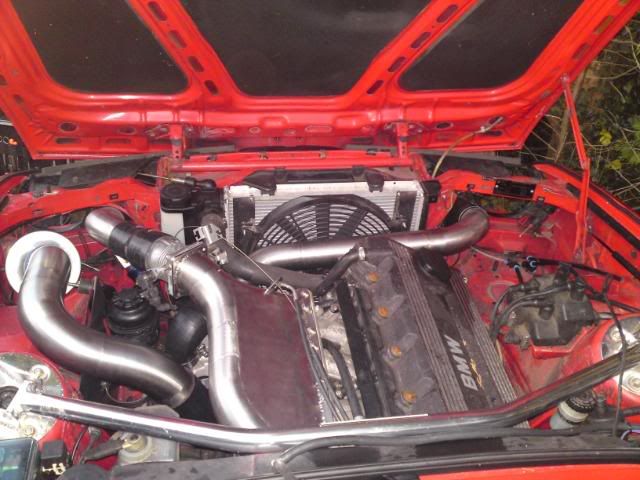
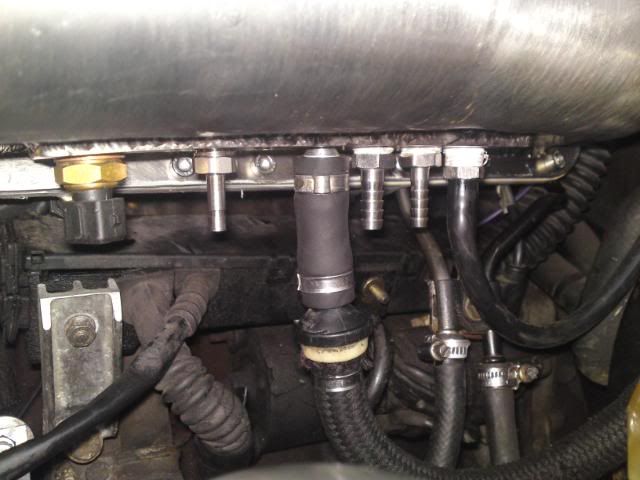
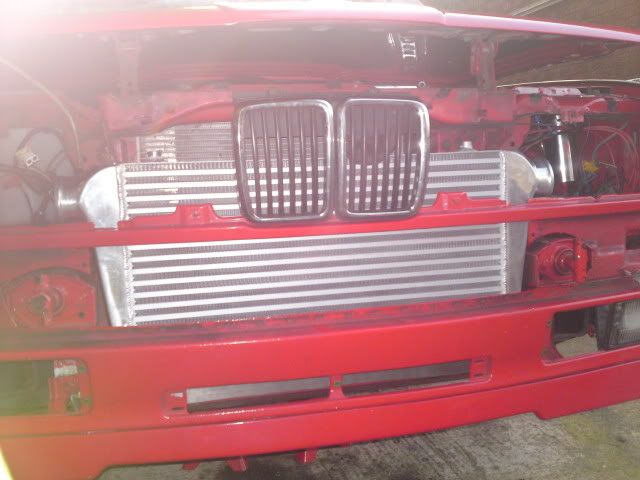
 hoping to make it abit more subtle soon with crack black pipeing instead of the shiney shiney stuff


