
Does anyone have any experience using these guy's products? In particular, I'm interested in this:
http://www.compbrake.co.uk/Pedal-Boxes/ ... od_24.html
I emailed them with a few questions but havn't had a response yet, thought I'd see if anyone else here has experience of this part or knows more about it before I give them a ring.
Basically I just want to know if it's a direct bolt on replacement for the servo (aside of course from routing new brake lines) and if it is fitted with a bias bar.
Cheers!
Compbrake Components
Moderator: martauto
-
BadDave
- E30 Zone Team Member

- Posts: 6012
- Joined: Sun Jan 09, 2005 11:00 pm
- Location: Nr Aberdeen.Scotland(Gods country)
I have one sitting in the shed which was fitted to Jasons(E21Jason)M3 by the previous owner.
It bolts straight on where the servo fits and does come with the balance bar fitted.IIRC Compbrake supply master cylinders included in the price.You need to specify which I/D you require for them though.Reservoirs are extra.
HTH
It bolts straight on where the servo fits and does come with the balance bar fitted.IIRC Compbrake supply master cylinders included in the price.You need to specify which I/D you require for them though.Reservoirs are extra.
HTH
Alpina B10 3.2L #187 (1 of 64 brought into the UK)
2.8L turbo build thread(work in progress)
http://www.e30zone.net/modules.php?name ... 27#1268227
2.8L turbo build thread(work in progress)
http://www.e30zone.net/modules.php?name ... 27#1268227
-
Motorhole
- E30 Zone Addict

- Posts: 2395
- Joined: Tue Jul 12, 2005 11:00 pm
- Location: Cheshire
Superb, thanks BadDave, just what I wanted to know! Time to add one to my shopping list. I may contact Compbrake and enquire about a bulk buy actually as I can imagine a few of the M50/M52 guys being interested in these.
I guess the right-hand drive ones wouldn't be M3 specific...?
I guess the right-hand drive ones wouldn't be M3 specific...?
-
BadDave
- E30 Zone Team Member
- Posts: 6012
- Joined: Sun Jan 09, 2005 11:00 pm
- Location: Nr Aberdeen.Scotland(Gods country)
The one I have fits your normal E30.
You'll most likely get 10% off if you were to buy 10.
I'd need to look out my 2011 catologue to check
You'll most likely get 10% off if you were to buy 10.
I'd need to look out my 2011 catologue to check
Alpina B10 3.2L #187 (1 of 64 brought into the UK)
2.8L turbo build thread(work in progress)
http://www.e30zone.net/modules.php?name ... 27#1268227
2.8L turbo build thread(work in progress)
http://www.e30zone.net/modules.php?name ... 27#1268227
-
GeoffBob
- Forced Induction Specialist
- Posts: 1843
- Joined: Tue Apr 28, 2009 11:00 pm
Motorhole, do a search on these in the Motorsport / Track-Day section using the search tool before you dive in and buy. There is, if I remember correctly, a catch to these, but I can't remember what it is. I think someone may have mentioned something about problems with regard to flex in the bar that runs from the brake pedal to the pedal box, but I stand corrected. I am sure others will be able to answer this one more accurately. I agree, however, that this would be an ideal solution for your purposes being that it is a bolt-on solution. You will, however, need to know both your stock E30 brake pedal ratio (this is well known and documented on here somewhere), as well as the ratio (additional leverage) provided by the bar that runs from the pedal to the pedal-box, in order to calculate your M/C sizes as a function of your brake disc, pad and calliper specs.
You seem to have all of your calculations under control as it is, but I'll happily double check values for you if you would like me to.
You seem to have all of your calculations under control as it is, but I'll happily double check values for you if you would like me to.

"It is amazing how many drivers, even at the Formula-1 level, think that brakes are for slowing the car down." - Mario Andretti
-
GeoffBob
- Forced Induction Specialist
- Posts: 1843
- Joined: Tue Apr 28, 2009 11:00 pm
I did a search and found the relevant post here
I had a feeling it would be one of MartinPallot's posts as he has put a lot of effort into his brake and pedal designs. Following what Martin wrote in that thread it would seem that the stock pedal combined with the brake transfer bar (as I see it is correctly called) gives a combined ratio of around 2:1, which is fine when operated with a brake booster, but of no use without. To overcome this problem either the ratio of the pedal, the bar, or both, must be adjusted (preferably to obtain a combined ratio of around 6:1, at which point you may need to look at a bigger brake transfer bar to stop it from flexing while braking).
You might also have a look at this thread here in which I initially argue the case for the compbrake pedalbox and Theo against, until Theo points out that with the reduced ratio it is virtually impossible to find M/C's small enough in order to regain the lost mechanical advantage. When I ran the maths I could only conclude that Theo was right and that the ratio of either the pedal or bar would have to be adjusted to make this idea work.
But don't let this put you off Motorhole. I only raise this issue so that you are aware, not to put you off the idea. Compared to building your own pedal box into your foot-well this hardly strikes me as an insurmountable problem.
I had a feeling it would be one of MartinPallot's posts as he has put a lot of effort into his brake and pedal designs. Following what Martin wrote in that thread it would seem that the stock pedal combined with the brake transfer bar (as I see it is correctly called) gives a combined ratio of around 2:1, which is fine when operated with a brake booster, but of no use without. To overcome this problem either the ratio of the pedal, the bar, or both, must be adjusted (preferably to obtain a combined ratio of around 6:1, at which point you may need to look at a bigger brake transfer bar to stop it from flexing while braking).
You might also have a look at this thread here in which I initially argue the case for the compbrake pedalbox and Theo against, until Theo points out that with the reduced ratio it is virtually impossible to find M/C's small enough in order to regain the lost mechanical advantage. When I ran the maths I could only conclude that Theo was right and that the ratio of either the pedal or bar would have to be adjusted to make this idea work.
But don't let this put you off Motorhole. I only raise this issue so that you are aware, not to put you off the idea. Compared to building your own pedal box into your foot-well this hardly strikes me as an insurmountable problem.
"It is amazing how many drivers, even at the Formula-1 level, think that brakes are for slowing the car down." - Mario Andretti
-
Motorhole
- E30 Zone Addict
- Posts: 2395
- Joined: Tue Jul 12, 2005 11:00 pm
- Location: Cheshire
Thanks Geoff, that's proved most useful. To be honest I've not had a couple of hours to sit down and do the maths properly, their all just "back of a fag packet" calcs in my head at the moment! And I didn't know what the standard E30 pedal ratio was.
I think I'll still go ahead and see what bulk-buy deals Compbrake can offer but I will crunch the numbers properly before putting up a group buy post. I'm not a little guy and can press 110kg with one leg but I don't fancy doing doing it 8 or 9 times a minute for 20 mins on a trackday!
I think I'll still go ahead and see what bulk-buy deals Compbrake can offer but I will crunch the numbers properly before putting up a group buy post. I'm not a little guy and can press 110kg with one leg but I don't fancy doing doing it 8 or 9 times a minute for 20 mins on a trackday!
-
Motorhole
- E30 Zone Addict
- Posts: 2395
- Joined: Tue Jul 12, 2005 11:00 pm
- Location: Cheshire
I think I'm also going to have to get my measuring tape out while the dash is out and try to spot any way in which the pedal ratio can be improved. It's shocking that the rhd cars loose out so much due to the the transfer bar! 2:1 is truly awful.
-
GeoffBob
- Forced Induction Specialist
- Posts: 1843
- Joined: Tue Apr 28, 2009 11:00 pm
The stock pedal is 4.25:1 according to Theo, so to arrive at a final ratio of 2:1 the ratio of the transfer bar would have to be 1:2.125. In other words, the fulcrum would have to be to the right of centre of the bar (servo on the left, pedals on the right, RHD). I have no idea how accurate that quoted value of 2:1 is Motorhole, but I wouldn't have thought it that difficult to have put the fulcrum in the centre of the bar and given it a ratio of 1:1, or is there something in the way? You'd definitely do best to measure it. Moving the fulcrum further to the left one could regain further mechanical advantage that is lost to the deleted servo. Keep in mind, of course, that your required ratio and M/C sizes are very much dependent upon the size of the callipers you decide to install. Oddly enough, bigger discs and callipers on race cars are more about returning lost mechanical advantage and improved heat dissipation than improved braking torque. Usable braking torque is still ultimately limited by your available tyre traction (as well know when it starts raining).Motorhole wrote:I think I'm also going to have to get my measuring tape out while the dash is out and try to spot any way in which the pedal ratio can be improved. It's shocking that the rhd cars loose out so much due to the the transfer bar! 2:1 is truly awful.
"It is amazing how many drivers, even at the Formula-1 level, think that brakes are for slowing the car down." - Mario Andretti
-
Motorhole
- E30 Zone Addict
- Posts: 2395
- Joined: Tue Jul 12, 2005 11:00 pm
- Location: Cheshire
No worries! I'll need to make time this week to do the measuring and crunch all the numbers. I will report back...
-
Motorhole
- E30 Zone Addict
- Posts: 2395
- Joined: Tue Jul 12, 2005 11:00 pm
- Location: Cheshire
There's one critical number I am missing at the moment, if someone could help me out that would be great!
E30 COG height (A stock 325i will do for estimation, but if someone has it for a stripped & caged M52-engined car, even better!)
Please excuse my many questions, I have undertook this project about 18 months ago with no prior mechanical experience and I am operating out of a rented 5x8 metre garage with a 3.2kW genny for power. I have learnt a lot but many more questions will come
E30 COG height (A stock 325i will do for estimation, but if someone has it for a stripped & caged M52-engined car, even better!)
Please excuse my many questions, I have undertook this project about 18 months ago with no prior mechanical experience and I am operating out of a rented 5x8 metre garage with a 3.2kW genny for power. I have learnt a lot but many more questions will come
-
GeoffBob
- Forced Induction Specialist
- Posts: 1843
- Joined: Tue Apr 28, 2009 11:00 pm
I used a rough estimate of 0.5m in the calculations I did for Theo. Take note that this figure is strongly dependent upon how far you have lowered the car, and assumes the glass windows have been replaced with polycarbonate all round.
If anyone else has a more accurate value I'm all ears.
If anyone else has a more accurate value I'm all ears.
"It is amazing how many drivers, even at the Formula-1 level, think that brakes are for slowing the car down." - Mario Andretti
-
Motorhole
- E30 Zone Addict
- Posts: 2395
- Joined: Tue Jul 12, 2005 11:00 pm
- Location: Cheshire
Ah, that's not bad! I got 0.46m based on an assumed 1080kg, 60/40 front/rear split and some basic trig 
-
Motorhole
- E30 Zone Addict
- Posts: 2395
- Joined: Tue Jul 12, 2005 11:00 pm
- Location: Cheshire
...yes...my calcs show that with E36 M3 Evo front brakes and 318ti compact rear brakes, using the smallest available MCs on that pedal box would require 108kg on the brake pedal to execute 1g. That's with a 4.25:1 pedal ratio. If it is indeed 2:1 with the transfer bar you would be looking at a whopping 228kg  Even the worlds strongest men would have a hard time driving that...
Even the worlds strongest men would have a hard time driving that...-
GeoffBob
- Forced Induction Specialist
- Posts: 1843
- Joined: Tue Apr 28, 2009 11:00 pm
Ah yes, but did you include yourself in the drivers seat in the calculation. Theo is quite tall and has a big headMotorhole wrote:Ah, that's not bad! I got 0.46m based on an assumed 1080kg, 60/40 front/rear split and some basic trig

"It is amazing how many drivers, even at the Formula-1 level, think that brakes are for slowing the car down." - Mario Andretti
-
Theo
- Old Skooler

- Posts: 10735
- Joined: Wed Jun 01, 2005 11:00 pm
- Location: Kent
Haha! I'm certainly not tall, the other bit rings true though
-
GeoffBob
- Forced Induction Specialist
- Posts: 1843
- Joined: Tue Apr 28, 2009 11:00 pm
That fits with what MartinPallot had to say about the brakes not working. I really am not sure about that 2:1 ratio though Motorhole, I wonder if that could be realy true? No transfer bar on my car for me to measure I am afraid.Motorhole wrote:...yes...my calcs show that with E36 M3 Evo front brakes and 318ti compact rear brakes, using the smallest available MCs on that pedal box would require 108kg on the brake pedal to execute 1g. That's with a 4.25:1 pedal ratio. If it is indeed 2:1 with the transfer bar you would be looking at a whopping 228kg
I'm sure I remember reading somewhere that someone had improved the ratio of the transfer bar but then ran into problems with the bar flexing, although a thicker bar or bit or reinforcing should sort that out.
Out of interest, what are the dimensions of your discs and callipers? To arrive at a figure of 108kg on a 4.25:1 pedal using the smallest M/C’s available likely means that your calliper piston area is a touch on the small side. I think it largely went unnoticed in my two brake upgrade threads that the primary reason for fitting bigger brakes to my car was to regain the leverage that was lost when the servo was deleted. The three primary ways to regain lost leverage after removing the servo are:
1) Fit callipers with greater piston surface area,
2) Fit M/C’s with smaller piston surface area
3) Increase the pedal ratio
Of course larger discs will also help, but here you are ultimately limited by what you can fit under your rims (although the same can ultimately be said for callipers). You are typically limited to around 6:1 on your pedal ratio due to space constraints in the foot-well. I think MartinPallot went higher than this (iirc) on his custom made pedals. It is worth keeping in mind that it is a misconception that it is only your pedal ratio that you need be concerned with in relation to pedal travel (since you are essentially exchanging travel for force), the rational being that if you make your pedal ratio too high the stroke of the pedal will be too big. In reality any of the above modifications (to discs, callipers and M/C’s included) that bring about a change in the mechanical leverage of the system, will bring about a change in the pedal travel. Speaking from experience I can assure you that, in the absence of a servo (and assuming your brakes are well adjusted and not overheating) your brakes will take from the very top of the pedal stroke. With servo assisted brakes the pedal ratio, and hence pedal travel while braking, are less. However, the initial travel due to the operation of the servo more than offsets the benefit (imo) that you may think that the servo provides. Of course the requirement for a servo on a modern road car (especially where the elderly are concerned) cannot be denied. On the race track I am, however, of the opinion that non-servo assisted brakes are superior. It is well worth keeping in mind, however, that just because you only ever seem to use the first cm or so of pedal travel on non-servo brakes doesn’t mean that you don’t need to keep the full stroke of the pedal (conveyed to the M/C) clear behind the pedal. The day will come when your brakes overheat and you’ll be very glad you have that extra-travel in reserve while avoiding that rapidly approaching wall of tyres! I am very lucky in this regard in that my brakes give me plenty of warning.
FYI, it is, by and large, generally assumed that bigger discs and callipers are fitted to improve brake torque, and it is true that with the semi-slick tyres and improved weight distribution on my track-car that I have sufficient traction to permit a marginally greater brake torque. That is, however, not the primary reason for upgrading the brakes. I would personally have to place linearity of the brakes (both brake torque and pedal travel being proportional to how hard I press the pedal) and heat dissipation at the top of my list. I have no doubt that with your servo deleted that you will feel the difference.
Motorhole, are you a MATLAB user, student edition or otherwise? If so then I have more detailed models that I can share with you. The calculations presented in that dual master cylinder selection document that I posted up are really quite basic, I have more detailed models that I have written if you would like. I am afraid I really don’t have time to type up instructions for these, although I have included comments in the models.
Last edited by GeoffBob on Wed May 18, 2011 10:10 am, edited 1 time in total.
"It is amazing how many drivers, even at the Formula-1 level, think that brakes are for slowing the car down." - Mario Andretti
-
GeoffBob
- Forced Induction Specialist
- Posts: 1843
- Joined: Tue Apr 28, 2009 11:00 pm
You're a good sport TheoTheo wrote:Haha! I'm certainly not tall, the other bit rings true though

"It is amazing how many drivers, even at the Formula-1 level, think that brakes are for slowing the car down." - Mario Andretti
-
Motorhole
- E30 Zone Addict
- Posts: 2395
- Joined: Tue Jul 12, 2005 11:00 pm
- Location: Cheshire
Hi Geoff, unfortunately I don't have access to Matlab. Surprisingly, being a physicist, our place of work makes do with Excel!
It's no wonder given that amount of force that the transfer bar would start flexing! Unfortunately my pedal assembly/transfer bar/servo assembly in many pieces at the moment so measurements arn't going to be ideal Either way, i think you're right, my calculations show that even with a 6:1 pedal ratio, the force required on the brake pedal is quite large, hence without significantly increasing piston area (i.e. moving away from bolt-on calipers available from the BMW range!) a pedal bias box appears to be impracticable. I'd guess for repeated heavy braking, you wouldn't really want to be putting more than about 50-60kg through the pedal?
It would be great if you could double-check my calcs to be sure, but I understand if you don't have the time
It's no wonder given that amount of force that the transfer bar would start flexing! Unfortunately my pedal assembly/transfer bar/servo assembly in many pieces at the moment so measurements arn't going to be ideal
Either way, i think you're right, my calculations show that even with a 6:1 pedal ratio, the force required on the brake pedal is quite large, hence without significantly increasing piston area (i.e. moving away from bolt-on calipers available from the BMW range!) a pedal bias box appears to be impracticable. I'd guess for repeated heavy braking, you wouldn't really want to be putting more than about 50-60kg through the pedal?It would be great if you could double-check my calcs to be sure, but I understand if you don't have the time
-
ross_jsy
- Married to the E30 Zone
- Posts: 7307
- Joined: Sun Jul 12, 2009 11:00 pm
- Location: Jersey, C.I.
I shall try and get a picture of the pedal box I will be using next time I am at my garage. It is the one Martin describes in the other thread. Made by a local guy over here it bolts up in place of the standard one.
I really don't like the idea of the link bar as used by BMW. It will always be a weak link and reduce the force being transferred and numb the feel of the brakes imo.
I really don't like the idea of the link bar as used by BMW. It will always be a weak link and reduce the force being transferred and numb the feel of the brakes imo.
-
GeoffBob
- Forced Induction Specialist
- Posts: 1843
- Joined: Tue Apr 28, 2009 11:00 pm
"It is amazing how many drivers, even at the Formula-1 level, think that brakes are for slowing the car down." - Mario Andretti
-
Motorhole
- E30 Zone Addict
- Posts: 2395
- Joined: Tue Jul 12, 2005 11:00 pm
- Location: Cheshire
I don't mind posting the figures up as they may be of use to someone else! Plus it allows people to correct me in case some of the data I have is wrong! Here goes:
Front brakes: Standard E36 M3 Evo Single Piston Calipers & Discs
Piston diameter: 60mm
Brake disc diameter: 315mm
Pad height: 64.1mm
Coefficient Friction: 0.5 (based on Ferodo DS2500 road/track pads)
Rear brakes: Standard E36 Compact 318ti calipers & discs
Piston diameter: 34mm
Brake disc diameter: 272mm
Pad height: 45.2mm
Coefficient Friction: 0.5 (based on Ferodo DS2500 road/track pads)
I assumed 16" rims with 225/45/R16 tyres for rolling diameter. 1g de acceleration rate and a 0.5m centre of gravity height. This may change slightly given I'm 6'1 and about 90kg.
Yes, I'm very glad you brought my attention to this matter! I'd rather not be one of the guys finding out that hard way that you can't stop your car from rolling into a gate at 5mph
Front brakes: Standard E36 M3 Evo Single Piston Calipers & Discs
Piston diameter: 60mm
Brake disc diameter: 315mm
Pad height: 64.1mm
Coefficient Friction: 0.5 (based on Ferodo DS2500 road/track pads)
Rear brakes: Standard E36 Compact 318ti calipers & discs
Piston diameter: 34mm
Brake disc diameter: 272mm
Pad height: 45.2mm
Coefficient Friction: 0.5 (based on Ferodo DS2500 road/track pads)
I assumed 16" rims with 225/45/R16 tyres for rolling diameter. 1g de acceleration rate and a 0.5m centre of gravity height. This may change slightly given I'm 6'1 and about 90kg.
Yes, I'm very glad you brought my attention to this matter! I'd rather not be one of the guys finding out that hard way that you can't stop your car from rolling into a gate at 5mph
-
Motorhole
- E30 Zone Addict
- Posts: 2395
- Joined: Tue Jul 12, 2005 11:00 pm
- Location: Cheshire
That would be ace, thanks Ross!ross_jsy wrote:I shall try and get a picture of the pedal box I will be using next time I am at my garage. It is the one Martin describes in the other thread. Made by a local guy over here it bolts up in place of the standard one.
I really don't like the idea of the link bar as used by BMW. It will always be a weak link and reduce the force being transferred and numb the feel of the brakes imo.
This would perhaps be a better option if attempting to increase the ratio of the transfer bar.
-
GeoffBob
- Forced Induction Specialist
- Posts: 1843
- Joined: Tue Apr 28, 2009 11:00 pm
Right, I've initially popped your values into a spreadsheet and posted it up for you to download here. I assumed your car to weigh at least 1200kg with you in it. I set the weight split at 60:40 and height of COG at 0.5m, as per your data.
With that said, I don't get nearly the same values that you do, so I suggest downloading that spreadsheet and having a look (I may have missed something). I can't help but notice that your front calliper is quite large. With a 60mm diameter piston it has a surface area larger than some available four-pots. If this is true then its good news for you. At a pedal ratio of 4.15:1 I calculate that you'll only need 42.5kg of pedal force to pull a 1.1g braking manoeuvre. That's with a 5/8" M/C connected to the front callipers, and a 7/10" connected to the rear.
That really is a very basic calculation though. I'll now have a look at popping the values into my MATLAB model and see what it spits out.
With that said, I don't get nearly the same values that you do, so I suggest downloading that spreadsheet and having a look (I may have missed something). I can't help but notice that your front calliper is quite large. With a 60mm diameter piston it has a surface area larger than some available four-pots. If this is true then its good news for you. At a pedal ratio of 4.15:1 I calculate that you'll only need 42.5kg of pedal force to pull a 1.1g braking manoeuvre. That's with a 5/8" M/C connected to the front callipers, and a 7/10" connected to the rear.
That really is a very basic calculation though. I'll now have a look at popping the values into my MATLAB model and see what it spits out.
"It is amazing how many drivers, even at the Formula-1 level, think that brakes are for slowing the car down." - Mario Andretti
-
e21Jason
- E30 Zone Addict
- Posts: 2040
- Joined: Tue Jan 11, 2005 11:00 pm
- Location: Dubai, UAE
I am using e36 m3 front, ti rear with a 6:1 OBP Pedal box, based on my vbox data i am getting 0.8g braking in a 100-30mph zone, from memory I am using 0.625 and 0.7 as I had to go a small as could with the previous pedal box which had a 4.5:1 ratio (not the one dave now has).
I found pads made the biggest differnce to the pedal feel and hence how fast I could attack the corner,I am using DS2500 and stock disks and they done a day at Spa followed by the ring with minimal wear
Jason
I found pads made the biggest differnce to the pedal feel and hence how fast I could attack the corner,I am using DS2500 and stock disks and they done a day at Spa followed by the ring with minimal wear
Jason
BMW e21 track car supercharged s14 cage and fabrication by www.chizfab.com
Z3M Coupe for sale
69 Alfa spyder
Z3M Coupe for sale
69 Alfa spyder
-
GeoffBob
- Forced Induction Specialist
- Posts: 1843
- Joined: Tue Apr 28, 2009 11:00 pm
Indeed, although that appears to work on the principle that when you put your foot on the pedal it pulls on the bar, thus overcoming the problem of flex. This means that the pedal requires some form of rod and pin mechanism on it to transform the forwards-backwards motion of the pedal into the side-to-side motion of the transfer bar.Motorhole wrote:
This would perhaps be a better option if attempting to increase the ratio of the transfer bar.
Or maybe that’s how the transfer bar works in the first place? I am totally unfamiliar with the RHD E30 brake transfer bar. I simply assumed it was a rigid bar with a pivot point somewhere along it, working like a see-saw (or teeter-totter as the yanks like to call them). I think I could be quite wrong in that assumption. If the pedal already includes a mechanism for converting the forwards-backwards movement of the pedal into side-to-side movement of the bar, then that mechanism shown in the above pic would be an ideal way to change the transfer ratio of the bar. It would also be easily accessible and hence easily adjustable.
Could someone in the know please provide a description of how the brake transfer bar works. Maybe even a pic of how it attaches to the top of the E30 RHD brake pedal. Many thanks.
"It is amazing how many drivers, even at the Formula-1 level, think that brakes are for slowing the car down." - Mario Andretti
-
Motorhole
- E30 Zone Addict
- Posts: 2395
- Joined: Tue Jul 12, 2005 11:00 pm
- Location: Cheshire
Thanks again Geoff! Most likely I've cocked up somewhere as I've not done calcs like this before, and I did them late last night with my girlfriend nagging me to come to bed! I'll have a look through later on though and see what's what and yes, those M3 pistons are massive...
and yes, those M3 pistons are massive...-
Motorhole
- E30 Zone Addict
- Posts: 2395
- Joined: Tue Jul 12, 2005 11:00 pm
- Location: Cheshire
Oops, never saw that last post! Yes, I can't remember how mine works and it;s in bits so I can't see. But I checked on Realoem earlier today and it does look like a pull mech rather than a push mech (oops  ) . Which means I don't know why a flexing bar would be a problem? Although the sketches are fairly rough, I also find it difficult to see how the ratio is reduced by the transfer bar, it looks like it should remain unchanged.

I believe part 14 connects to the pedal pivot. Hopefully someone with a complete and working pedal assembly to hand will post on here soon!
) . Which means I don't know why a flexing bar would be a problem? Although the sketches are fairly rough, I also find it difficult to see how the ratio is reduced by the transfer bar, it looks like it should remain unchanged. I believe part 14 connects to the pedal pivot. Hopefully someone with a complete and working pedal assembly to hand will post on here soon!
-
GeoffBob
- Forced Induction Specialist
- Posts: 1843
- Joined: Tue Apr 28, 2009 11:00 pm
Ah I see, it is a rod and pin type affair. Silly me assuming otherwise. Well, we all know what they say about assumptions! Looking at that drawing, so long parts 6 and 15 have identical dimensions then there can be no change in ratio. In other words it's simply a mechanism to shift the brake pedal from the left to the right side of the car. TBH, it didn't make sense to me that the LHD cars would have a different "effective" pedal ratio to the RHD cars. Where MartinPallot got that 2:1 figure from I do not know.
One thing I can see though: The maximum you can swing part 15 through (clockwise, when you put your foot on the pedal) is probably about 45 to 60 degrees, right? If you think about it that effectively dictates the maximum stroke of the pedal. I am not sure if I would want my pedal stroke limited by the top of my pedal colliding with the transfer bar when my brakes start to overheat!
One thing I can see though: The maximum you can swing part 15 through (clockwise, when you put your foot on the pedal) is probably about 45 to 60 degrees, right? If you think about it that effectively dictates the maximum stroke of the pedal. I am not sure if I would want my pedal stroke limited by the top of my pedal colliding with the transfer bar when my brakes start to overheat!
"It is amazing how many drivers, even at the Formula-1 level, think that brakes are for slowing the car down." - Mario Andretti
-
e21Jason
- E30 Zone Addict
- Posts: 2040
- Joined: Tue Jan 11, 2005 11:00 pm
- Location: Dubai, UAE
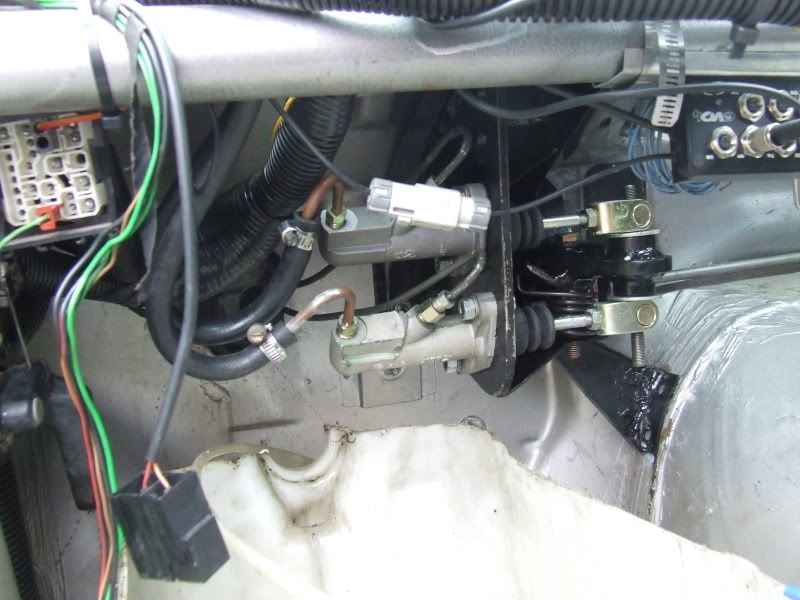
I used a cockpit mount pedal box you can just see here and lost all the linkages etc

BMW e21 track car supercharged s14 cage and fabrication by www.chizfab.com
Z3M Coupe for sale
69 Alfa spyder
Z3M Coupe for sale
69 Alfa spyder
-
GeoffBob
- Forced Induction Specialist
- Posts: 1843
- Joined: Tue Apr 28, 2009 11:00 pm
OK, a few MATLAB graphs for you from a slightly more advanced model that takes the dynamic (time dependent) weight shift of the car into account while you are braking. The assumption is that you are on a flat piece of straight road. The intention is to illustrate braking peformance in order to assist you setup your brakes, you can then fine tune on the track based upon actual tyre and track conditions.
Shown below is a graph of deceleration as a function of pedal force for your brake and car setup with a 5/8" front and 7/10" rear M/C. The bias-bar between the two M/C's is set to 50%, that is to say. mid way between the two, dividing the force equally between the two M/C's. The pedal ratio is set to 4.25:1. Tyres and brakes are as you described earlier. I have assumed semi-slick tyres on dry tarmac. Don't go trying this on a wet track! Also shown is what I call the front and rear traction fractions. These are simply two graphs illustrating the fraction of the available traction that has been consumed. Exceeding a value of 1 puts the car into a skid. These graphs are useful since they can illustrate quite nicely when a car is or isn’t utilising either set of brakes. Putting the front wheels into a skid, for example, while only 50% of the available traction at the rear has been consumed can be considered a bad setup, and will ultimately reduce the maximum possible deceleration before the onset of a skid. The figure below indicates that with the bias bar set to 50% we can expect no better than 0.8g of deceleration before the front wheels exceed their threshold of traction.

Adjusting the bias bar to achieve a 60% rewards bias is observed to improve the situation somewhat, resulting in a maximum deceleration of typically around 1.1g at 42kg of pedal force just before the rear wheels lose traction. Take a close look at this graph and observe how the rear traction fraction rapidly tails up as the rear loses weight and the threshold of traction is approached. It’s at this point that you’d get that awful ”alight”a feeling and your arse starts to overtake your nose. Well, that’s if you drive anything like I do

In my next post I’ll show you how you can drastically improve upon both of these results.
Shown below is a graph of deceleration as a function of pedal force for your brake and car setup with a 5/8" front and 7/10" rear M/C. The bias-bar between the two M/C's is set to 50%, that is to say. mid way between the two, dividing the force equally between the two M/C's. The pedal ratio is set to 4.25:1. Tyres and brakes are as you described earlier. I have assumed semi-slick tyres on dry tarmac. Don't go trying this on a wet track! Also shown is what I call the front and rear traction fractions. These are simply two graphs illustrating the fraction of the available traction that has been consumed. Exceeding a value of 1 puts the car into a skid. These graphs are useful since they can illustrate quite nicely when a car is or isn’t utilising either set of brakes. Putting the front wheels into a skid, for example, while only 50% of the available traction at the rear has been consumed can be considered a bad setup, and will ultimately reduce the maximum possible deceleration before the onset of a skid. The figure below indicates that with the bias bar set to 50% we can expect no better than 0.8g of deceleration before the front wheels exceed their threshold of traction.
Adjusting the bias bar to achieve a 60% rewards bias is observed to improve the situation somewhat, resulting in a maximum deceleration of typically around 1.1g at 42kg of pedal force just before the rear wheels lose traction. Take a close look at this graph and observe how the rear traction fraction rapidly tails up as the rear loses weight and the threshold of traction is approached. It’s at this point that you’d get that awful ”alight”a feeling and your arse starts to overtake your nose. Well, that’s if you drive anything like I do
In my next post I’ll show you how you can drastically improve upon both of these results.
"It is amazing how many drivers, even at the Formula-1 level, think that brakes are for slowing the car down." - Mario Andretti
-
GeoffBob
- Forced Induction Specialist
- Posts: 1843
- Joined: Tue Apr 28, 2009 11:00 pm
Jason, Motorhole isn't keen to do any welding, but if that pedal-box of yours is bolt-in than that looks like the one to go fore21Jason wrote:I used a cockpit mount pedal box you can just see here and lost all the linkages etc
. I really don't like the look of the E30 RHD brake linkage and the way it connects to the pedal. If I may ask, what's the chance you'll impale your shins on the M/C's in the event of an accident, or scold your feet if you boil your fluid?
"It is amazing how many drivers, even at the Formula-1 level, think that brakes are for slowing the car down." - Mario Andretti
-
e21Jason
- E30 Zone Addict
- Posts: 2040
- Joined: Tue Jan 11, 2005 11:00 pm
- Location: Dubai, UAE
The pedal box is made by using the existing pedal box as a template for a piece of sheet steel that bolts up to the OEM mounts, all the throttle pedal bits where transfered over on the new back plate then one of these welded to it.
http://www.obpltd.com/obp-shop/race-car ... hyd-clutch
The reservoirs are in the engine bay, boiled the fluid once and never had a problem
The masters are up pretty high and you could probably modify the under dash panel to cover them
Jason
http://www.obpltd.com/obp-shop/race-car ... hyd-clutch
The reservoirs are in the engine bay, boiled the fluid once and never had a problem
The masters are up pretty high and you could probably modify the under dash panel to cover them
Jason
BMW e21 track car supercharged s14 cage and fabrication by www.chizfab.com
Z3M Coupe for sale
69 Alfa spyder
Z3M Coupe for sale
69 Alfa spyder
-
Theo
- Old Skooler
- Posts: 10735
- Joined: Wed Jun 01, 2005 11:00 pm
- Location: Kent
Slight detour from the subject matter here, how hot does brake fluid in a reservoir actually get?
-
billgatese30
- E30 Zone Team Member
- Posts: 10989
- Joined: Sun Jan 09, 2005 11:00 pm
- Location: Tyne & Wear
I've often wondered this and have a gadget that would tell me (temp probe) but forgot it on the last few trackdays I went on so never found out.Theo wrote:Slight detour from the subject matter here, how hot does brake fluid in a reservoir actually get?
