
Anyone know how to measure the cam profile?
The comp gauge I used was 300psi and it went off the gauge! 250 psi was what i thought the gauge ended at as it was not around when i posted the note. I have fitted a Ve pully and retarded cam 10mm so now need to re-check with new gauge soon as possible and post info.
2.9 stroker pinging
Moderator: martauto
-
GeoffBob
- Forced Induction Specialist
- Posts: 1843
- Joined: Tue Apr 28, 2009 11:00 pm
You'll need an engineers 360 degree protractor attached to the end of your crank, like that shown here. These are available to both bolt or stick on and in a variety of sizes. They also come with markings either clockwise or anti-clockwise (which is handy if you work on Honda engines).Sebastian35 wrote:Anyone know how to measure the cam profile?
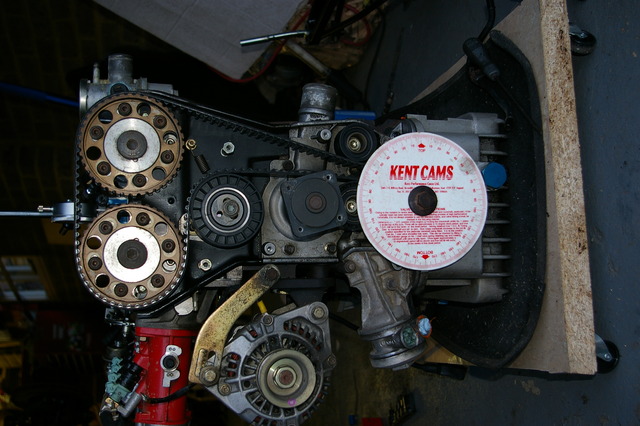
Obviously you need to keep all your timing gear intact, but everything else can come out to gain improved access if needs be. Start by getting your #1 cylinder (or which ever cylinder you choose to work with) to TDC at the top of the compression stroke (when all valves on that cylinder should be closed). Now lock your protractor on the end of your crank/pulley so that it reads 0 degrees. You'll need to set up a convenient pointer to point to the zero for this. A bit of stiff fencing wire locked under the head of a nearby bolt (or similar) works well for this, or sometimes there’s a convenient object nearby to serve as a pointer.
Now the tricky bit for which you’ll need an engineers dial-gauge, such as that shown below.
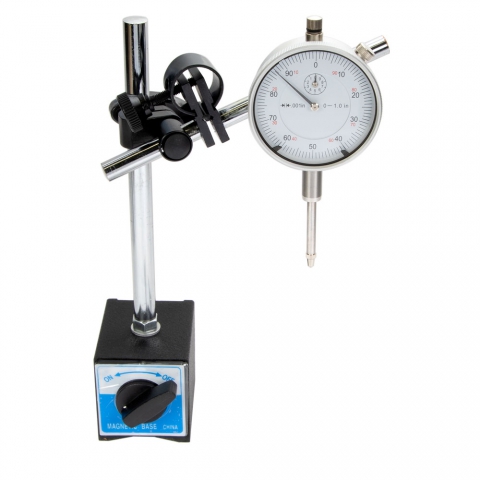
These come with a magnetic base to hold the gauge firmly in place on a mild-steel surface, but which is of little use on an alloy head. You will, therefore, need to make a plan to secure the dial gauge to the head (I am assuming you are doing this job with the engine in situ but with the valve cover removed). A bit of steel plate with some holes in the right place can help with this ”“ you’ll figure it out as you go along.
The rest of this process is fairly simply. Locate the dial gauge so that the nib rests conveniently on either end of one of the rocker arms. I don't have a mental picture as to where would be the most convenient position to rest the nib, but just be aware that if you do it on the valve side (which will be falling not rising) that you will need to factor in the rocker arm ratio in order to relate the measured valve lift to the cam lift. Measure on the cam side and you are obviously measuring the rise of the cam directly. You can of course remove the rockers and float the nib of the dial gauge directly on the cam face, which is the generally accepted way of doing it, just be sure to locate the nib exactly where the rocker would sit on the cam face. If you float the nib on a rocker arm be sure to have the nib travel in a direction that is aligned to the axis of the cam (if on the cam side) or aligned with the axis of the valve (if on the valve side).
Now get yourself some graph paper and plot yourself a graph of cam lift (or valve lift if that's what you want to know) vs crank angle. Remember it will take two turns of the crank for one turn of the cam, so your plot will be from 0 degrees angle to 720 degrees of crank angle.
Take note that, if all you are interested in is the profile of your cam on an engine, but don't care about its orientation to the crank, then you can perform a similar process but with the protractor fitted to the cam pulley/sprocket. In your case, however, we are concerned that your cam timing may be out, resulting in a high dynamic CR, so the relation between your cam and crank is important, so do it with the protractor fitted to the crank. I’d suggest taking measurements every 20 degrees or crank rotation, which is every 10 degrees of cam rotation. That’ll give you 36 data points in all. Any fewer than that and your plotted cam profile will start to look rough.
FYI, see this thread here from someone who measured his cams on a Lancia engine. He used a digital dial gauge which is useful, convenient and accurate.
Happy measuring.
HTH
Geoff
EDIT: And don't let some knob-head crank the engine over while while you're doing this. It REALLY stuffs up the dial gauge

Last edited by GeoffBob on Wed May 11, 2011 10:45 am, edited 1 time in total.

"It is amazing how many drivers, even at the Formula-1 level, think that brakes are for slowing the car down." - Mario Andretti
-
GeoffBob
- Forced Induction Specialist
- Posts: 1843
- Joined: Tue Apr 28, 2009 11:00 pm
Oh dear, this is not good Sebastian. greater than 300psi is a seriously high compression pressure. High compression ratio Honda motors running racing fuel only ever record up to 270psi. I honestly think you are going to have to look at lowering your CR. I honestly believe that you would run into valve clearance issues before your valve timing could become so bad as to cause such high compression pressures, assuming that your static CR is as specified. I can, therefore, only conclude that your static CR is much too high.Sebastian35 wrote:The comp gauge I used was 300psi and it went off the gauge! 250 psi was what i thought the gauge ended at as it was not around when i posted the note.
A further concern for me is that you have fitted forged pistons. These have a coefficient of expansion that is slightly higher than that of a stock cast piston. It is, thus, standard practice to bore slightly larger when fitting forged pistons due to the fact that the piston will expand slightly more than a cast piston. If you don't take this into account a forged piston will become tight and scuff the bore when the engine is at operating temperature. What this means is that an engine with forged pistons usually tests LOW when it is compression tested cold. A few squirts of oil into the chamber to seal the rings (much like on a poked engine) will close up the gap for a short while and bring the test up to spec. Now, if your engine was specifically bored for forged pistons (I assume you told your engineer you were boring for forged pistons?) and you are testing over 300 psi cold pressure then the "ideal" pressure to which I refer above must be huge on your engine!
To get to the bottom of this I need to know the details of your JE pistons. Specifically, what is the distance between the centre of the wrist/gudgeon pin to the piston crown?
Also, what gasket did you use?
With this info I can simply calculate your static CR for you. Regardless of which cam you choose or how you adjust it, once your engine comes "on cam" your engine's volumetric efficiency (VE) will approach a value of 1. If that means nothing to you, don't worry. But understand this, at that point in time, your engines dynamic CR is "effectively" the same as its static CR, that's why static CR is still such an important number to deal with. You can play all you like with your cam timing, but if your static CR is too high your engine will get screwed over the moment it comes "on cam". Hence, we need to look, first and foremost, at your static CR.
"It is amazing how many drivers, even at the Formula-1 level, think that brakes are for slowing the car down." - Mario Andretti
-
Sebastian35

- E30 Zone Newbie

- Posts: 78
- Joined: Wed Sep 02, 2009 11:00 pm
Thanks Sir im going to start from scratch. I will dig out my invoice and see again if Top end can help with the parts they supplied! As for the engine i told them i was boring to 85mm and pistons were supplied with that in mind! i think they are correct as piston slap is to be heard on cold start up for a snap!
At the moment i have retarded the cam 10mm but the exhaust valve was not sealing and ran bad! Note the valves never hit pistons! would that suggest the wrong cam? now i have moved the cam to 7mm retard and it runs ok! still lumpy ect. I will see if i can get some miles on the colck.
the last thing i want to do is change pistons as they was not cheap....Could i have head work in the chambers to lower the compressiom! maybe one of those thicker gaskets to tide me over the summer? the later not ideal in my eyes tho! I put my trust in top end as to sell me parts that compliment each other but i am very sure something is a miss.
It will be a few days before i do another compression test but hopefully my engine was a warm engine first time round! as a guess i would say the comp was around 320psi when i first di it. Give me a few days to get some hard facts.
Thanks Sebastian
At the moment i have retarded the cam 10mm but the exhaust valve was not sealing and ran bad! Note the valves never hit pistons! would that suggest the wrong cam? now i have moved the cam to 7mm retard and it runs ok! still lumpy ect. I will see if i can get some miles on the colck.
the last thing i want to do is change pistons as they was not cheap....Could i have head work in the chambers to lower the compressiom! maybe one of those thicker gaskets to tide me over the summer? the later not ideal in my eyes tho! I put my trust in top end as to sell me parts that compliment each other but i am very sure something is a miss.
It will be a few days before i do another compression test but hopefully my engine was a warm engine first time round! as a guess i would say the comp was around 320psi when i first di it. Give me a few days to get some hard facts.
Thanks Sebastian
-
GeoffBob
- Forced Induction Specialist
- Posts: 1843
- Joined: Tue Apr 28, 2009 11:00 pm
Unfortunately you cannot manufacture a piston to match a bore, you have to bore a block to match a piston. Standard procedure is to take your pistons along to the engineering works with you and measure them across the broadest part of the piston skirt with a micrometer. Armed with that measurement you decide what to bore the block to based upon the type of piston you are using. At least this is how I usually do it.Sebastian35 wrote:i told them i was boring to 85mm and pistons were supplied with that in mind! i think they are correct as piston slap is to be heard on cold start up for a snap
Before you try and put any miles on the clock I would first get to the bottom of this problem and find out if it is safe to do so! I know it's tempting to drive the car after all the work you have put in, but you could very well be two steps away from destroying your engine. For example, adjusting your cam timing should not effect your valve seal. Exactly when your valves open and close does not effect by how much they open and close, unless they start to impact the pistons! Unfortunately, you are dealing with a SOHC engine and adjusting your single vernier pulley will adjust both your inlet and exhaust valve timing. FYI, retarding your inlet valve timing (to reduce your dynamic CR) will result in your exhaust valve closing later as the piston approaches TDC, meaning that it will be open for longer at the end of the exhaust stroke, and thus closer to the piston crown. By retarding your cam you do not risk your inlet valves since these now open later and are thus further from the piston crown which is departing TDC. Your exhaust valves are, however, at risk. You will note that in none of my posts above did I advise adjusting your cam timing for the simple reason that you have not yet posted the details of your pistons or cams, except as to mention elsewhere (thanks for that link reggid) that they are flat topped. Do they not even have valves cut-outs in them Sebastian? I am beginning to think more and more that these are the wrong pistons for your engine. Can you remember off hand where they came to relative to the deck when you turned the crank?Sebastian35 wrote:At the moment i have retarded the cam 10mm but the exhaust valve was not sealing and ran bad! Note the valves never hit pistons! would that suggest the wrong cam? now i have moved the cam to 7mm retard and it runs ok! still lumpy etc. I will see if i can get some miles on the clock.
the last thing i want to do is change pistons as they was not cheap....Could i have head work in the chambers to lower the compression! maybe one of those thicker gaskets to tide me over the summer? the latter not ideal in my eyes tho! I put my trust in top end as to sell me parts that compliment each other but i am very sure something is a miss.
Sorry, I don't mean to rattle your cage, but by now you have spent a lot of money and you could easily lose the whole lot. Do be careful fiddling blindly. What you think is the sound of piston slap could easily be the sound of a valve getting intimate with a piston!
"It is amazing how many drivers, even at the Formula-1 level, think that brakes are for slowing the car down." - Mario Andretti
-
Sebastian35
- E30 Zone Newbie
- Posts: 78
- Joined: Wed Sep 02, 2009 11:00 pm
There are no valves touching pistons that's for sure. I always crank the engine without plugs in , and by hand first!
The pistons however do have cut outs and did pop up out the block a little. My problem is I ordered parts and was told what bore size I needed for the pistons and was aware of slightly larger clearances when fitted into bore but as i was told my bore size and i suppose the rest was up to them! I personally think all is well down there! If only they would respond to my emails and help. Supply me with the info I need. However I doubt this will happen! So I will have to do it the hard way and start pulling things apart.....
It will be next week before i get chance to pull the head off, then i can deck the pistons, then raise them fully and take the a measurement. Would this help you guys calculate CR?
I will post my findings as soon as guys.......
How do I add pictures to this Topic?
The pistons however do have cut outs and did pop up out the block a little. My problem is I ordered parts and was told what bore size I needed for the pistons and was aware of slightly larger clearances when fitted into bore but as i was told my bore size and i suppose the rest was up to them! I personally think all is well down there! If only they would respond to my emails and help. Supply me with the info I need. However I doubt this will happen! So I will have to do it the hard way and start pulling things apart.....
It will be next week before i get chance to pull the head off, then i can deck the pistons, then raise them fully and take the a measurement. Would this help you guys calculate CR?
I will post my findings as soon as guys.......
How do I add pictures to this Topic?
-
GeoffBob
- Forced Induction Specialist
- Posts: 1843
- Joined: Tue Apr 28, 2009 11:00 pm
Excellent.Sebastian35 wrote:There are no valve touching pistons that's for sure.
Good.Sebastian35 wrote:I always crank the engine without plugs in , and by hand first!
Looking at them from the side, do they have a squish band (a chamfered edge) around the side looking like they were made to stick up out of the block. If they had a squish band and looked like this:Sebastian35 wrote:The pistons however do have cut outs and did pop up out the block a little.
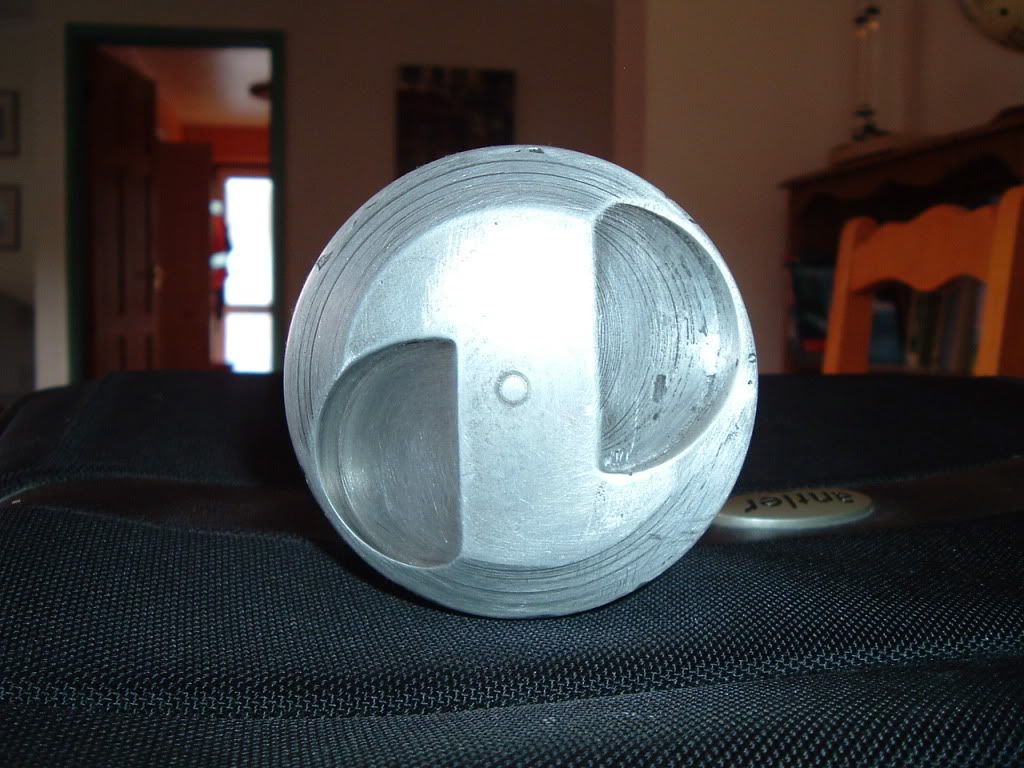
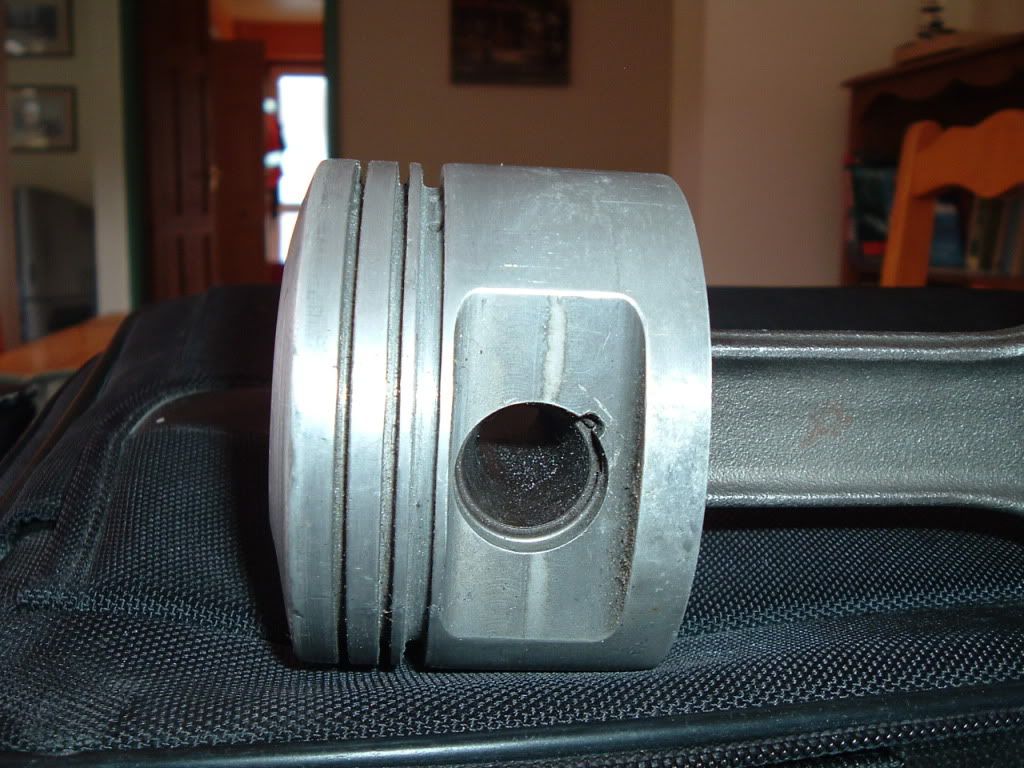
then you have something akin to a high compression version of the M20B25 piston. In your case, however, your piston has been custom made by JE with the wrist-pin located ~29.7mm from the crown of the piston (excluding the dome) since the m20B25 stack-height is 206.7mm and you have a 84mm stroke crank with 135mm rods. Those two pictures were taken by Kimbo and he claims a static CR of 11.5:1 (see here) which is not far of your quoted value of 11.2:1, in which case you may just have a tuning issue. For this to be the case though your pressure value of 300psi plus has to a mistake due to a faulty gauge. I still maintain that there is no way you will get a pressure reading that high purely as a result of bad cam timing affecting your dynamic CR! There is of course a possibility that JE didn’t take enough off the piston dome during manufacture, in which case the 46cc that should separate your piston from your head at TDC at a static CR of 11.2:1 has been reduced to some lesser value giving you a higher static CR, and hence your problem.
Once I get some detailed piston dimensions from you then I can tell you more.
Last edited by GeoffBob on Fri Jun 10, 2011 10:23 pm, edited 1 time in total.
"It is amazing how many drivers, even at the Formula-1 level, think that brakes are for slowing the car down." - Mario Andretti
-
GeoffBob
- Forced Induction Specialist
- Posts: 1843
- Joined: Tue Apr 28, 2009 11:00 pm
Indeed. Redo your compression test first though.Sebastian35 wrote:It will be next week before i get chance to pull the head off, then i can deck the pistons, then raise them fully and take the a measurement. Would this help you guys calculate CR?
Good.Sebastian35 wrote: I will post my findings as soon as guys
Find a host for your pictures, Photobucket or similar, then copy and paste a link to your pic into your post. Detailed instructions hereSebastian35 wrote:How do I add pictures to this Topic?
"It is amazing how many drivers, even at the Formula-1 level, think that brakes are for slowing the car down." - Mario Andretti
-
GeoffBob
- Forced Induction Specialist
- Posts: 1843
- Joined: Tue Apr 28, 2009 11:00 pm
One last thing, if your piston is like zoner Kimbo's one shown above then it's a far from ideal design. Zoner HairyScreech specialises in this sort of thing and had this to say in his thread here:
Sebastian, just so we are clear on this, you are absolutely positive that you have an 885 head on your engine, and not a 731 head? I can't remember if you sated this explicitly anywhere yet, and the obvious answer might be that you have a 731 head on your engine. That’ll certainly give you a higher than expected CR. I am not sure why I assumed you had an 885 head on your engine from the start, but I guess it must have been said somewhere along the line.
HairyScreech wrote:kimbo, i question the use of the hemi chamber in the m20 at all now, with the plug offset as it is and the increase in combustion volume causing the need for a highly domed piston such as yours, the shape of the combustion chamber is totally ruined, its turned into a curved disc shape, which is a prime way to cause det and require retarded ignition.
Sebastian, just so we are clear on this, you are absolutely positive that you have an 885 head on your engine, and not a 731 head? I can't remember if you sated this explicitly anywhere yet, and the obvious answer might be that you have a 731 head on your engine. That’ll certainly give you a higher than expected CR. I am not sure why I assumed you had an 885 head on your engine from the start, but I guess it must have been said somewhere along the line.
"It is amazing how many drivers, even at the Formula-1 level, think that brakes are for slowing the car down." - Mario Andretti
-
Gunni
- E30 Zone Addict

- Posts: 2115
- Joined: Tue Jan 11, 2005 11:00 pm
- Location: Oxford
300psi sounds almost impossible. I´m not sure if any pump fuel can run that sort of engine at full load with MBT ignition advance no matter the camshaft.
Hope this gets sorted and the issues discovered.
Hope this gets sorted and the issues discovered.
-
gooner1
- Out humping Reindeer
- Posts: 13280
- Joined: Fri Apr 14, 2006 11:00 pm
- Location: Northampton.For my sins.
Geoff, Sebastian states this right at the start of the threadGeoffBob wrote:One last thing, if your piston is like zoner Kimbo's one shown above then it's a far from ideal design. Zoner HairyScreech specialises in this sort of thing and had this to say in his thread here:
HairyScreech wrote:kimbo, i question the use of the hemi chamber in the m20 at all now, with the plug offset as it is and the increase in combustion volume causing the need for a highly domed piston such as yours, the shape of the combustion chamber is totally ruined, its turned into a curved disc shape, which is a prime way to cause det and require retarded ignition.
Sebastian, just so we are clear on this, you are absolutely positive that you have an 885 head on your engine, and not a 731 head? I can't remember if you sated this explicitly anywhere yet, and the obvious answer might be that you have a 731 head on your engine. That’ll certainly give you a higher than expected CR. I am not sure why I assumed you had an 885 head on your engine from the start, but I guess it must have been said somewhere along the line.
Sebastian35 wrote:Engine pinging and need help!
block fitted with m52 crank and rods, pistons are +1mm JE and head is 885. Need advice!

-
Sebastian35
- E30 Zone Newbie
- Posts: 78
- Joined: Wed Sep 02, 2009 11:00 pm
looking at all the pictures of pistons they are not like mine?
I have no dome on the top!
I have no dome on the top!
Last edited by Sebastian35 on Thu May 12, 2011 9:00 am, edited 1 time in total.
-
reggid
- E30 Zone Squatter

- Posts: 1984
- Joined: Mon Jul 11, 2005 11:00 pm
- Location: Oz
Would it not be better to use the dial indicator on the rocker? This would indicate the valve timing events which are all that the engine sees.GeoffBob wrote:Oh dear, this is not good Sebastian. greater than 300psi is a seriously high compression pressure. High compression ratio Honda motors running racing fuel only ever record up to 270psi. I honestly think you are going to have to look at lowering your CR. I honestly believe that you would run into valve clearance issues before your valve timing could become so bad as to cause such high compression pressures, assuming that your static CR is as specified. I can, therefore, only conclude that your static CR is much too high.Sebastian35 wrote:The comp gauge I used was 300psi and it went off the gauge! 250 psi was what i thought the gauge ended at as it was not around when i posted the note.
A further concern for me is that you have fitted forged pistons. These have a coefficient of expansion that is slightly higher than that of a stock cast piston. It is, thus, standard practice to bore slightly larger when fitting forged pistons due to the fact that the piston will expand slightly more than a cast piston. If you don't take this into account a forged piston will become tight and scuff the bore when the engine is at operating temperature. What this means is that an engine with forged pistons usually tests LOW when it is compression tested cold. A few squirts of oil into the chamber to seal the rings (much like on a poked engine) will close up the gap for a short while and bring the test up to spec. Now, if your engine was specifically bored for forged pistons (I assume you told your engineer you were boring for forged pistons?) and you are testing over 300 psi cold pressure then the "ideal" pressure to which I refer above must be huge on your engine!
To get to the bottom of this I need to know the details of your JE pistons. Specifically, what is the distance between the centre of the wrist/gudgeon pin to the piston crown?
Also, what gasket did you use?
With this info I can simply calculate your static CR for you. Regardless of which cam you choose or how you adjust it, once your engine comes "on cam" your engine's volumetric efficiency (VE) will approach a value of 1. If that means nothing to you, don't worry. But understand this, at that point in time, your engines dynamic CR is "effectively" the same as its static CR, that's why static CR is still such an important number to deal with. You can play all you like with your cam timing, but if your static CR is too high your engine will get screwed over the moment it comes "on cam". Hence, we need to look, first and foremost, at your static CR.
I would redo the compression test with a different gauge just to confirm that the high numbers are as high as they look, it is a pretty simple process with not much to lose from doing it. Follow the steps in the Bentley manual if you didn’t before.
If the numbers are more reasonable it may be a tuning (ignition timing) thing most likely it is more than this though based on the severity of symptoms and this would most likely compromise the effectiveness.
Then I would check cam timing marks and setup a system like you described to work out the valve timing events as that will give a good indication of the static CR back calculating from the pressure test.
Then if the pressures are still exceptionally high in either case the head needs to come off for a cam change at which time you can truly calculate the CR and get a cam to suit. IMO if the true CR is below 11.5 you can get away with a cam swap (this king of CR is not uncommon) if it is higher than 11.5 you need a rather large cam which may cause piston to valve clearance issues in which case you may need new pistons if the cutouts are not large/deep enough.
In theory you could lower the CR with a thicker gasket or maybe increasing the combustion chamber volume but wait until you pinpoint the issue before you decide on the solution as some are more ideal than others.
E30 325is with M20B31
-
GeoffBob
- Forced Induction Specialist
- Posts: 1843
- Joined: Tue Apr 28, 2009 11:00 pm
Thanks Gooner. After making so many other assumptions during my calculations I was worried that I may have at some point simply assumed that the OP had an 885 head. If you assume something for long enough you eventually begin to believe it's fact. I had completely forgotten that Sebastian stated it clearly in his very first postgooner1 wrote:Geoff, Sebastian states this right at the start of the threadGeoffBob wrote:Sebastian, just so we are clear on this, you are absolutely positive that you have an 885 head on your engine, and not a 731 head? I can't remember if you staed this explicitly anywhere yet, and the obvious answer might be that you have a 731 head on your engine. That’ll certainly give you a higher than expected CR. I am not sure why I assumed you had an 885 head on your engine from the start, but I guess it must have been said somewhere along the line.

"It is amazing how many drivers, even at the Formula-1 level, think that brakes are for slowing the car down." - Mario Andretti
-
GeoffBob
- Forced Induction Specialist
- Posts: 1843
- Joined: Tue Apr 28, 2009 11:00 pm
"It is amazing how many drivers, even at the Formula-1 level, think that brakes are for slowing the car down." - Mario Andretti
-
GeoffBob
- Forced Induction Specialist
- Posts: 1843
- Joined: Tue Apr 28, 2009 11:00 pm
I couldn't agree more Gunni. John Heywood says it very nicely in his book "Internal combustion Fundamentals":Gunni wrote:300psi sounds almost impossible. I´m not sure if any pump fuel can run that sort of engine at full load with MBT ignition advance no matter the camshaft.
"The Brake Mean Effective Pressure (BMEP) of most production spark-ignition engines at wide open throttle is knock-limited over part of the engine speed range. The compression ratio is usually set at a sufficiently high value so as that some spark retard from Mean Best Torque (MBT) timing is needed to avoid knock for the expected range of available fuel octane"
I think the emphasis here should be on the fact that "some" spark retard is required to avoid knock. My point is this: The instant you build you a high compression motor that requires spark retard across the entire range of rpm and throttle openings, it somewhat defeats the objective to building the high CR engine in the first place.
On pump fuel, an engine showing 300psi on a compression test hasn’t a farts chance in a hurricane (imo) of being tuned to MBT at any engine speed when placed under load. One answer to this, BTW, would be to leave the engine as is and convert it to a high octane or knock resistant fuel such as LPG or methanol. Methanol would be drag-racing only down here (and wouldn’t go down too well in the UK either I suspect) and we don't get LPG for cars, but in the UK LPG sounds like a winner to me? Just had a discussion with someone else over this. 110 octane I believe? Sounds like one possible option.
Last edited by GeoffBob on Thu May 12, 2011 9:03 am, edited 1 time in total.
"It is amazing how many drivers, even at the Formula-1 level, think that brakes are for slowing the car down." - Mario Andretti
-
e301988325i
- E30 Zone Addict
- Posts: 3701
- Joined: Fri Feb 01, 2008 11:00 pm
- Location: Taunton, Somerset
Epic thread, it's this sort of thing that keeps me lurking!!
In response to one of Geoff's numerous questions, flat top pistons don't work well in an M20 ref Hairyscreech's thread, accordingly it is important to maintain the offset bowl.
A quote from this thread:
http://www.e30zone.net/modules.php?name ... 15&start=0
The left is a JE made pistons for a 2.8 M20, with a non standard pin height to suit 135mm rods, which copy the original offset combustion bowl. The right stock M20.
In response to one of Geoff's numerous questions, flat top pistons don't work well in an M20 ref Hairyscreech's thread, accordingly it is important to maintain the offset bowl.
A quote from this thread:
http://www.e30zone.net/modules.php?name ... 15&start=0
The left is a JE made pistons for a 2.8 M20, with a non standard pin height to suit 135mm rods, which copy the original offset combustion bowl. The right stock M20.
ezagood wrote:
mmmm shiny
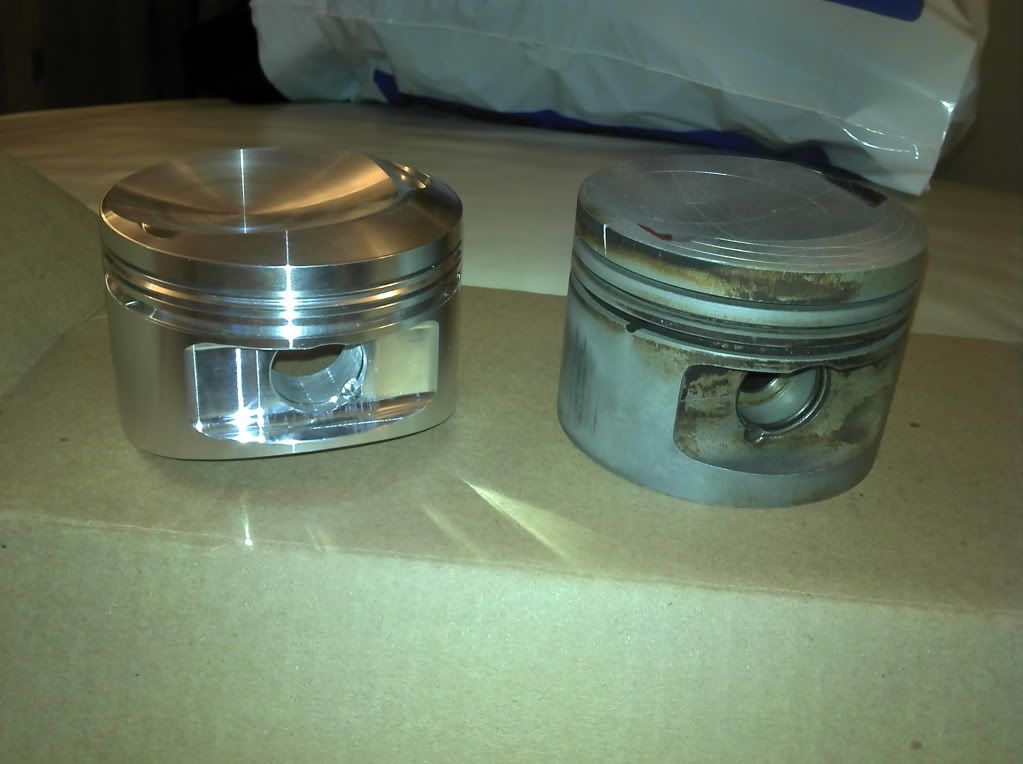
I said:
Can anyone suggest how to test if the boot lights are staying on with the boot shut?
e30topless said:
lock the wife in there
Can anyone suggest how to test if the boot lights are staying on with the boot shut?
e30topless said:
lock the wife in there
-
Sebastian35
- E30 Zone Newbie
- Posts: 78
- Joined: Wed Sep 02, 2009 11:00 pm
The head i have is 885 as its written on the side! the donor engine was an early sport Hi comp engine; the block and head is all that is left of the donor, i have all the other bits still. looking at the original pistons they are very different to the onels i removed as there was a Dome, JE ones are quite flat. I did question this with the suplier and they said all is ok as they use the flat type over here!
In reference to your question about the squish band the JE pistons i have just had a little taper of around 3mm at the edge if that. If you send me a private message with your email i will forward you some pictures?
Tomorrow i will pick up a new compression gauge but it may be saturday before i get to post results though!
What are your views on a cometic thicker head gasket?
Not ideal but it gets me throught the summer and i can strip it down again in the winter and machine pistons if thats needed?
Thanks for the research so far!
In reference to your question about the squish band the JE pistons i have just had a little taper of around 3mm at the edge if that. If you send me a private message with your email i will forward you some pictures?
Tomorrow i will pick up a new compression gauge but it may be saturday before i get to post results though!
What are your views on a cometic thicker head gasket?
Not ideal but it gets me throught the summer and i can strip it down again in the winter and machine pistons if thats needed?
Thanks for the research so far!
-
Sebastian35
- E30 Zone Newbie
- Posts: 78
- Joined: Wed Sep 02, 2009 11:00 pm
I keep looking at the pictures of those pistons!
I did not receive anything like that from Top End!
Can anyone send me a private message with there email address in and I will send the pictures of the build....
I have also read over the Emails i originally sent to Top End as one of my concerns was this issue. I suggest to them I have the wrong pistons as they do not have a dome to match the head but they assured me all was ok! And they will work fine....
Where do I go from here -can I ever get the engine to work with flat tops?
firstly I need you guys to see what I put in the dame thing!
No wonder Top End do not reply to my emails.
I see metric mechanic use flat tops too!
Maybe a phone call to Top End is in order!
I did not receive anything like that from Top End!
Can anyone send me a private message with there email address in and I will send the pictures of the build....
I have also read over the Emails i originally sent to Top End as one of my concerns was this issue. I suggest to them I have the wrong pistons as they do not have a dome to match the head but they assured me all was ok! And they will work fine....
Where do I go from here -can I ever get the engine to work with flat tops?
firstly I need you guys to see what I put in the dame thing!
No wonder Top End do not reply to my emails.
I see metric mechanic use flat tops too!
Maybe a phone call to Top End is in order!
Last edited by Sebastian35 on Thu May 12, 2011 9:35 am, edited 2 times in total.
-
GeoffBob
- Forced Induction Specialist
- Posts: 1843
- Joined: Tue Apr 28, 2009 11:00 pm
"It is amazing how many drivers, even at the Formula-1 level, think that brakes are for slowing the car down." - Mario Andretti
-
GeoffBob
- Forced Induction Specialist
- Posts: 1843
- Joined: Tue Apr 28, 2009 11:00 pm
Short answer this time, imo, yes. Maybe not an ideal solution, but yes. Maybe some machining required, or maybe just a decompression gasket, but I think you will get there in the end. If, however, an ideal solution is what you are seeking, then you may have to look at something shaped like that custom JE piston zoner Ezagood originally posted.Sebastian35 wrote:Where do I go from here -can I ever get the engine to work with flat tops?
"It is amazing how many drivers, even at the Formula-1 level, think that brakes are for slowing the car down." - Mario Andretti
-
GeoffBob
- Forced Induction Specialist
- Posts: 1843
- Joined: Tue Apr 28, 2009 11:00 pm
Two of the pics that Sebastian mailed me showing his flat-top JE pistons:


Clearly a very limited squish band. I would expect that the piston is designed to function in such a way that the absence of the dome compensates for the absence of the bowl (at least in terms of the CR). The flame angle (the angle swept by the crank over the duration of the combustion process) and the flame area (the surface area of the flame front) will be different between the two chamber shapes. However, following the work of Haywood (he speaks volumes in both chapters 9 and 15 of his book Internal Combustion Engine Fundamentals) there is little difference it seems between the true hemi chamber (as favoured by the Americans) and the "clam-shell" or "open" chamber favoured by BMW. As Reggid mentioned earlier, however, BMW did see fit to redesign their piston and lower the compression ratio of the M20B25. Am I mistaken, however, in thinking that this corresponded in Europe with the introduction of unleaded fuel, and was not a failing as such of the high compression piston, but rather an indication of the lower knock resistance of the new unleaded fuel? Someone in the know please feel free to comment as I am no expert in this regard. If this is true I would expect the old flat top design to be as unforgiving today as it was when unleaded was first introduced.
Sebastian, looking at your piston crown (and its difficult to tell without actual dimensions to hand) the dome of your piston appears lower than that in Kimbo’s picture (also a flat topped piston with the claimed 11.5:1 CR), and so I would expect that your claimed CR value of 11.2:1 is true, in which case your compression tester must surely be faulty? I await the results of your next compression test with anticipation.
Clearly a very limited squish band. I would expect that the piston is designed to function in such a way that the absence of the dome compensates for the absence of the bowl (at least in terms of the CR). The flame angle (the angle swept by the crank over the duration of the combustion process) and the flame area (the surface area of the flame front) will be different between the two chamber shapes. However, following the work of Haywood (he speaks volumes in both chapters 9 and 15 of his book Internal Combustion Engine Fundamentals) there is little difference it seems between the true hemi chamber (as favoured by the Americans) and the "clam-shell" or "open" chamber favoured by BMW. As Reggid mentioned earlier, however, BMW did see fit to redesign their piston and lower the compression ratio of the M20B25. Am I mistaken, however, in thinking that this corresponded in Europe with the introduction of unleaded fuel, and was not a failing as such of the high compression piston, but rather an indication of the lower knock resistance of the new unleaded fuel? Someone in the know please feel free to comment as I am no expert in this regard. If this is true I would expect the old flat top design to be as unforgiving today as it was when unleaded was first introduced.
Sebastian, looking at your piston crown (and its difficult to tell without actual dimensions to hand) the dome of your piston appears lower than that in Kimbo’s picture (also a flat topped piston with the claimed 11.5:1 CR), and so I would expect that your claimed CR value of 11.2:1 is true, in which case your compression tester must surely be faulty? I await the results of your next compression test with anticipation.
"It is amazing how many drivers, even at the Formula-1 level, think that brakes are for slowing the car down." - Mario Andretti
-
eta
- E30 Zone Regular

- Posts: 356
- Joined: Fri Oct 26, 2007 11:00 pm
- Location: Glemsford Suffolk
BMW also dropped the CR of the eta engine from 11.0:1 to 10.2:1 in september 1985 becouse of knocking on 95 RON unleaded fuel.
Eta engines where designed with flat top pistons. So in summary use flat top pistons with a hemi head like the 731 then?
Eta engines where designed with flat top pistons. So in summary use flat top pistons with a hemi head like the 731 then?
Last edited by eta on Thu May 12, 2011 8:14 pm, edited 1 time in total.
-
Sebastian35
- E30 Zone Newbie
- Posts: 78
- Joined: Wed Sep 02, 2009 11:00 pm
Hi Guys i made time do do the compression test with a brand new gauge and not a cheap thing! Although if i spend any more time in that workshop im sure my partner will take a hammer to it one of these days!
Firstly i warmed up engine then removed sparks, disconected the injector loom and opened the throttle..
Results are.... All cylinders were a touch over 270 psi but the gauge would rest bang on 270psi.
Geoff i have emailed you a very short video for reference along with a few more pictures of interest.
Thank you for posting the other pics on my behalf.
Geoff a long shot but would the valves increase the comp as the old ones had dishes in them and the new ones are flat? Also could i have the head worked so the comp was lowered and the chambers were symmetrical? I do however have a 731 head that may match the block better but would need work to mach the 885 head.
Right Guys where do i go from here?
Firstly i warmed up engine then removed sparks, disconected the injector loom and opened the throttle..
Results are.... All cylinders were a touch over 270 psi but the gauge would rest bang on 270psi.
Geoff i have emailed you a very short video for reference along with a few more pictures of interest.
Thank you for posting the other pics on my behalf.
Geoff a long shot but would the valves increase the comp as the old ones had dishes in them and the new ones are flat? Also could i have the head worked so the comp was lowered and the chambers were symmetrical? I do however have a 731 head that may match the block better but would need work to mach the 885 head.
Right Guys where do i go from here?
-
GeoffBob
- Forced Induction Specialist
- Posts: 1843
- Joined: Tue Apr 28, 2009 11:00 pm
Well that would certainly explain why Sebastian is experiencing detonation at 11.2:1 on local premium. With his flat topped pistons it sounds like the shape of his combustion chamber is reasonably similar to an ETA motor? Ta for that Eta.eta wrote:BMW also dropped the CR of the eta engine from 11.0:1 to 10.2:1 in september 1985 becouse of knocking on 95 RON unleaded fuel.
"It is amazing how many drivers, even at the Formula-1 level, think that brakes are for slowing the car down." - Mario Andretti
-
GeoffBob
- Forced Induction Specialist
- Posts: 1843
- Joined: Tue Apr 28, 2009 11:00 pm
Goodness that is high (well, by my forced induction standards anyway). OK, fair enough, we know it’s a high compression engine, so we knew it would be high, and thank goodness it wasn’t over 300psi after all! 270psi truly is racing fuel territory though. The B18 Honda motors that I have seen making those sort of pressures were all running on 104 octane racing fuel and I have no idea how much of the time they were able to achieve MBT (I am sure they were retarded some of the time to avoid knocking).Sebastian35 wrote:Hi Guys i made time do do the compression test with a brand new gauge and not a cheap thing! Although if i spend any more time in that workshop im sure my partner will take a hammer to it one of these days!
Firstly i warmed up engine then removed sparks, disconected the injector loom and opened the throttle..
Results are.... All cylinders were a touch over 270 psi but the gauge would rest bang on 270psi.
By my calculation the only way you could be making 270psi on an engine that is genuinely running at a static CR of 11.2:1 (and looking at your pics I can well believe this to be true) is if your inlet valves are closing at approximately 50 degrees after BDC. That’s at least 20 degrees too soon in your case. Now, 20 degrees of crank rotation equates to 10 degrees of cam rotation. That’s got to be at least one pulley tooth or thereabouts? Any chance that your belt is out by a tooth. I’d honestly suggest that you take a look at that. Just be clear in your head on the difference between advancing and retarding a cam. It’s a mistake I have made many times before and still make to this day. Looking from the front at the engine the crank turns clockwise, hence the cam pulley also turns clockwise. If you want to retard the cam then you remove the belt, turn the cam pulley (and hence cam) anti-clockwise, and then put the belt back. Mark the belt and pulley with typing fluid or similar so that you know afterwards that you have in fact moved it one tooth back. Now the valves will open and close later because the cam now lags (is one tooth behind) where it was before. Be sure to check for valve clearance issues by cranking the engine by hand before you try to run the engine.
If that turns out to be the problem then a repeat compression test should indicate 230psi next time around.
However, if this isn’t the problem then I would suggest that you measure your cam profile as I described to you on page 2 of this thread. You’ll need a protractor and dial gauge for that, and probably need to rip most everything out from in front of the engine so that you can get access to read the protractor. Lets face it, at some point in time your are going to need to find out what cam it is that you have, and if Top End won’t tell you then you’ll need to measure it yourself.
You’re welcome. I’ll have a look at the video and pics when I’m in at work tomorrow morning.Sebastian35 wrote:Geoff i have emailed you a very short video for reference along with a few more pictures of interest.
Thank you for posting the other pics on my behalf.
Any volume that has been filled would indeed raise the compression ratio. I can only imagine, however, that the dish in the valve would account for a few cc’s of volume at the most. But every little bit counts.Sebastian35 wrote:Geoff a long shot but would the valves increase the comp as the old ones had dishes in them and the new ones are flat? Also could i have the head worked so the comp was lowered and the chambers were symmetrical? I do however have a 731 head that may match the block better but would need work to mach the 885 head
Given that your piston includes little or no squish band around its edge, I think your piston is reasonably compatible with a decompression gasket. It won’t be ideal, but it’s worth a try before you go spending a fortune on machining out the head to find extra volume. Opening up the chambers around the valves on an 885 head would indeed be a good idea in the long run. Since you aren’t using a domed piston it’s not as if you need a shape that is compatible with the piston dome. The machining on each of the six chambers will have to be identical though or you’ll land up with an imbalance between cylinders.
"It is amazing how many drivers, even at the Formula-1 level, think that brakes are for slowing the car down." - Mario Andretti
-
Sebastian35
- E30 Zone Newbie
- Posts: 78
- Joined: Wed Sep 02, 2009 11:00 pm
The timing marks are spot on. That was the first thing I checked. Before I fitted the VE pully i did move the cam: retarded by 1 tooth and that did lower the compression but would that just be the dynamic comp? Someone did say that the true compression will still be there higher up the rev range so i put the marks back to standard. I can Retard the cam 10 degrees on the VE without any valves touching pistons, could that suggest a wrong cam?
can the cam be out even if the marks are correct as there is a larger throw crank fitted?
I will call Top End tomorrw and ask then what cam i have as it looks more and more suspect every day.
I built the engine on a stand and had a clear view of all marks and I always rotate an engine a few times and check again and again, so i am sure the marks are ok. Nevertheless with the cam retarded i can get the car to run but it will ping under load still! I had been playing with the cam from day one as i know cam retard reduces dynamic comp but not static. Is that so? You are spot on with the comp test with one tooth back, but as i say it will ping under load still but i could run the engine like this readying a tune....
I am happy to have the head worked! but would need to know a volume for chambers to be?
Any thoughts!
A gasket is an easy fix but i would always know in the back of my mind the pistons do not match the head! Hence i would rather get the head done if you think that would sort me out?
To me the latter is the way forward as i have already had new guides and fitted new valves in the head! As far the cam is concerned i can always put a new one in so i know whats what!
Maybe thats the route of my troubles a small cam? what cam would you suggest?
What would be a realistic CR for uk 99 octane fuel! My Hi CR engine dream has fast faded away ........! A leson to be learned here somewhere i think.
can the cam be out even if the marks are correct as there is a larger throw crank fitted?
I will call Top End tomorrw and ask then what cam i have as it looks more and more suspect every day.
I built the engine on a stand and had a clear view of all marks and I always rotate an engine a few times and check again and again, so i am sure the marks are ok. Nevertheless with the cam retarded i can get the car to run but it will ping under load still! I had been playing with the cam from day one as i know cam retard reduces dynamic comp but not static. Is that so? You are spot on with the comp test with one tooth back, but as i say it will ping under load still but i could run the engine like this readying a tune....
I am happy to have the head worked! but would need to know a volume for chambers to be?
Any thoughts!
A gasket is an easy fix but i would always know in the back of my mind the pistons do not match the head! Hence i would rather get the head done if you think that would sort me out?
To me the latter is the way forward as i have already had new guides and fitted new valves in the head! As far the cam is concerned i can always put a new one in so i know whats what!
Maybe thats the route of my troubles a small cam? what cam would you suggest?
What would be a realistic CR for uk 99 octane fuel! My Hi CR engine dream
has fast faded away ........! A leson to be learned here somewhere i think.-
GeoffBob
- Forced Induction Specialist
- Posts: 1843
- Joined: Tue Apr 28, 2009 11:00 pm
"It is amazing how many drivers, even at the Formula-1 level, think that brakes are for slowing the car down." - Mario Andretti
-
GeoffBob
- Forced Induction Specialist
- Posts: 1843
- Joined: Tue Apr 28, 2009 11:00 pm
Don't get despondent Sebastian. Before jumping to any conclusions we need to ascertain facts. Without the required data on your engine its hard to say why your engine is doing what it is doing. In your cold climate and at generally low altitude 11:1 is quite doable on 100 RON fuel, so I shouldn't think 11.2:1 on 99 Octane presents too much of a challenge, assuming these figures are real.Sebastian35 wrote:What would be a realistic CR for uk 99 octane fuel! My Hi CR engine dream
BTW, How long did your car stand with petrol in the tank before you fired up your new engine? Did you then drain the tank and fill it with 99RON or did you just top it up? The octane boosting components in modern unleaded are highly unstable and decay rapidly! Old fuel in your tank could easily be the cause of your problem. All too many budding star-ship pilots have been thwarted because they left petrol in the tank during their project build!
What you might also consider is the state of your ECU: What is it and what is it currently mapped for? Did you load new fuel and ignition maps to get your 2.9 stroker running, or is your ECU mapped for something else per chance? Did you change the size of your injectors? What I am asking is, could your engine be running lean? Do you have an AFR gauge on your exhaust to check this? Also, just how badly out could your ignition timing be and for what reasons? Have you confirmed your timing with a timing light?
I would hate to start recommending that you machine out so many cc of material from the top of a piston or from the head if it turns out that you have attempted to run your engine from a fuel and ignition map that is incompatible with your engine, or it turns out that you are actually trying to run it on a tank of cabbage juice

Whatever the case, don’t despair. An answer will arise as fast as the facts do.
"It is amazing how many drivers, even at the Formula-1 level, think that brakes are for slowing the car down." - Mario Andretti
-
Sebastian35
- E30 Zone Newbie
- Posts: 78
- Joined: Wed Sep 02, 2009 11:00 pm
I wished that was the case! while the engine was out, so too was the tank and axle, I replaced all fuel lines, brake pipes and suspension, you name it its new!
As for fuel I put in normal fuel to start, a few Ltrs, then filled with 99 shell Vpower and on top of that i brought some Tetra Boost (a real lead substance to make even 99 into 105 octane) i mixed it 100mls to 10Lts of fuel, that put me around the 5 star fuel mark.
It is not legal to put more that 100mls to 11 Ltrs of 99 octane.
But 100ml to 3.3 Ltrs makes 105 racing fuel, Haven't tried that i have to say! Tempting tho
As i said before with the Dynamic CR lowered by about 10 degrees and the fuel with Tetra boost i can drive the car on light throttle but that is not going to fix anything. Besides Tetra boost is not for nothing! but it can get me to a Dyno if its a tune issue.
Though i do not want to waste a day on the dyno to be told its a no no!
Or have the engine retarded as you said all through the rev range either....
The Ecu is a 173 Motronic with Miller Chip and MFA. The injectors are 19lb and have used all the base programs and others but still the same outcome.
I also had a 179 Motronic with a M30 AFM this works great ticked over nice with the bigger AFM and set up for the 19lb injectors from the factory, but ping under load still. Infact I was so happy with that set up that is what i may use in the end as it looks factory under the hood. I am now back to the Miller as at least i could make change settings there. Although i make the fuel rich or retard the timing that is all i have changed, (I do not know enough to do more really) I have been trying and the Zone was the next step after many late nights of reading, so I am very happy for all the info I have received to date.
As for fuel I put in normal fuel to start, a few Ltrs, then filled with 99 shell Vpower and on top of that i brought some Tetra Boost (a real lead substance to make even 99 into 105 octane) i mixed it 100mls to 10Lts of fuel, that put me around the 5 star fuel mark.
It is not legal to put more that 100mls to 11 Ltrs of 99 octane.
But 100ml to 3.3 Ltrs makes 105 racing fuel, Haven't tried that i have to say! Tempting tho
As i said before with the Dynamic CR lowered by about 10 degrees and the fuel with Tetra boost i can drive the car on light throttle but that is not going to fix anything. Besides Tetra boost is not for nothing! but it can get me to a Dyno if its a tune issue.
Though i do not want to waste a day on the dyno to be told its a no no!
Or have the engine retarded as you said all through the rev range either....
The Ecu is a 173 Motronic with Miller Chip and MFA. The injectors are 19lb and have used all the base programs and others but still the same outcome.
I also had a 179 Motronic with a M30 AFM this works great ticked over nice with the bigger AFM and set up for the 19lb injectors from the factory, but ping under load still. Infact I was so happy with that set up that is what i may use in the end as it looks factory under the hood. I am now back to the Miller as at least i could make change settings there. Although i make the fuel rich or retard the timing that is all i have changed, (I do not know enough to do more really) I have been trying and the Zone was the next step after many late nights of reading, so I am very happy for all the info I have received to date.
Last edited by Sebastian35 on Fri May 13, 2011 10:46 pm, edited 1 time in total.
-
Sebastian35
- E30 Zone Newbie
- Posts: 78
- Joined: Wed Sep 02, 2009 11:00 pm
Hi Geoff
I made the call to Top End! The guy was infact very very helpful and I now have the info you require!
The Cam I have is there owm 075 and here is the spec:
Cam Duration for inlet and exhaust is 278 degrees
Cam lift is 10.5mm
Centre Lobe angle is stock spec. (what ever that is?)
Inlet and Exhaust open at 66 and close at 28 degrees
Stock Head gasket is 1.8 or .070ins
Total volume is 6cc (11.18 Compression)
30-40 tho squish band
He said i must have great piston seal to make 170psi; and suggested i try a .90ins head gasket. This should give me a CR of 10.6 and also a better flame pattern!
What do you make of all That?
I made the call to Top End! The guy was infact very very helpful and I now have the info you require!
The Cam I have is there owm 075 and here is the spec:
Cam Duration for inlet and exhaust is 278 degrees
Cam lift is 10.5mm
Centre Lobe angle is stock spec. (what ever that is?)
Inlet and Exhaust open at 66 and close at 28 degrees
Stock Head gasket is 1.8 or .070ins
Total volume is 6cc (11.18 Compression)
30-40 tho squish band
He said i must have great piston seal to make 170psi; and suggested i try a .90ins head gasket. This should give me a CR of 10.6 and also a better flame pattern!
What do you make of all That?
-
GeoffBob
- Forced Induction Specialist
- Posts: 1843
- Joined: Tue Apr 28, 2009 11:00 pm
"It is amazing how many drivers, even at the Formula-1 level, think that brakes are for slowing the car down." - Mario Andretti
-
Sebastian35
- E30 Zone Newbie
- Posts: 78
- Joined: Wed Sep 02, 2009 11:00 pm
I have covered 210 miles in the car whilst trying various things to fix issues!
I even drove to work a 80mile round trip with no issues other than the odd ping if i had go up a hill.
Drove constant on the by road for 20 mins at 60 mph and never getting hot!
If pistons were to tight surely it would quickly get hot?
I even drove to work a 80mile round trip with no issues other than the odd ping if i had go up a hill.
Drove constant on the by road for 20 mins at 60 mph and never getting hot!
If pistons were to tight surely it would quickly get hot?