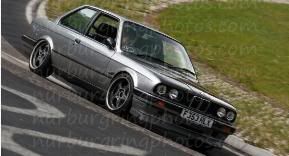
For those who have one installed, how have you got it set up and what effect did it have your cars performance/braking?
What i'm considering: http://www.compbrake.co.uk/brake_p9.htm
Pedal bias box?
Moderator: martauto
-
GeoffBob
- Forced Induction Specialist
- Posts: 1843
- Joined: Tue Apr 28, 2009 11:00 pm
Kit,
Replacing a tandem master cylinder (M/C) with a dual M/C setup (with bias bar) will help you to optimise the braking torque at each wheel. In any braking manoeuvre the objective is to apply the maximum braking torque to each wheel possible (in order to slow down as fast as possible) without breaking traction. A bias bar, which essentially divides the force applied to the pedal between separate front and rear M/C's, is a valuable tool to have when you wish to maintain optimum braking torque at each wheel. Note that optimum is not always the maximum braking torque that your calipers can deliver and depends upon tyre, track and weather conditions, and your cars dynamic weight distribution during that braking manoeuvre. The point is, you want to get the best deceleration you can out of what you have at that moment in time, and being able to adjust your brake bias helps you get that.
Probably the most important aspect of the setup (imo) is the sizing/selection of the M/C's.
For further info I'd suggest you read/join in with Theo325's thread here
Regards
Geoff
Replacing a tandem master cylinder (M/C) with a dual M/C setup (with bias bar) will help you to optimise the braking torque at each wheel. In any braking manoeuvre the objective is to apply the maximum braking torque to each wheel possible (in order to slow down as fast as possible) without breaking traction. A bias bar, which essentially divides the force applied to the pedal between separate front and rear M/C's, is a valuable tool to have when you wish to maintain optimum braking torque at each wheel. Note that optimum is not always the maximum braking torque that your calipers can deliver and depends upon tyre, track and weather conditions, and your cars dynamic weight distribution during that braking manoeuvre. The point is, you want to get the best deceleration you can out of what you have at that moment in time, and being able to adjust your brake bias helps you get that.
Probably the most important aspect of the setup (imo) is the sizing/selection of the M/C's.
For further info I'd suggest you read/join in with Theo325's thread here
Regards
Geoff
-
Theo
- Old Skooler

- Posts: 10735
- Joined: Wed Jun 01, 2005 11:00 pm
- Location: Kent
That 'pedalbox' that compbrake sell isn't worth having in my opinion. It's just a braket with twin master cylinders which bolts to the bulkhead in place of the original brake servo. So not only are you retaining the crappy brake linkage, you're also running a 4.25 (iirc) pedal ratio without servo assist which is very low.
-
GeoffBob
- Forced Induction Specialist
- Posts: 1843
- Joined: Tue Apr 28, 2009 11:00 pm
Sorry to disagree Theo, but the mechanical advantage lost with the shorter pedals (4.25 compared to say 6) can be regained with the correct choice of M/C's. For example, choosing a smaller diameter M/C has the same mechanical effect as fitting a taller ratio pedal (as do both increase the pedal travel). So long as the correct M/C's are fitted I see no problem with this setup, although I do agree with regard to the issue of the brake linkage, which is less than desireable. However, for someone who doesn't want to go to the extreme of fitting a full pedal set, I think it's worth a look at.Theo325 wrote:That 'pedalbox' that compbrake sell isn't worth having in my opinion. It's just a braket with twin master cylinders which bolts to the bulkhead in place of the original brake servo. So not only are you retaining the crappy brake linkage, you're also running a 4.25 (iirc) pedal ratio without servo assist which is very low.
-
UweM3
- E30 Zone Squatter

- Posts: 1657
- Joined: Sun Jul 03, 2005 11:00 pm
one thing comes to my mind, how small can ou go (speaking of M/C)?
I mean to overcome that little bit of slack till the pads/disks are in contact and pressure can be build up. Sure there must be an increase in "dead" pedal travel if your caliper/piston size ver M/C psiton size is not quite right. (in terms of fluid supply to the caliper/pistons)
I mean to overcome that little bit of slack till the pads/disks are in contact and pressure can be build up. Sure there must be an increase in "dead" pedal travel if your caliper/piston size ver M/C psiton size is not quite right. (in terms of fluid supply to the caliper/pistons)
-
Kit_L
- E30 Zone Newbie

- Posts: 90
- Joined: Fri May 29, 2009 11:00 pm
- Location: Mid-Wales, Powys
Thanks for your advice and info GeoffBob 
Which brand/model would you recommend Theo?Theo325 wrote:That 'pedalbox' that compbrake sell isn't worth having in my opinion. It's just a braket with twin master cylinders which bolts to the bulkhead in place of the original brake servo. So not only are you retaining the crappy brake linkage, you're also running a 4.25 (iirc) pedal ratio without servo assist which is very low.
-
Theo
- Old Skooler
- Posts: 10735
- Joined: Wed Jun 01, 2005 11:00 pm
- Location: Kent
True, but as Uwe mentioned you're rather limited when looking for smaller master cylinders, I've not seen anything below .625.GeoffBob wrote:Sorry to disagree Theo, but the mechanical advantage lost with the shorter pedals (4.25 compared to say 6) can be regained with the correct choice of M/C's. For example, choosing a smaller diameter M/C has the same mechanical effect as fitting a taller ratio pedal (as do both increase the pedal travel). So long as the correct M/C's are fitted I see no problem with this setup, although I do agree with regard to the issue of the brake linkage, which is less than desireable. However, for someone who doesn't want to go to the extreme of fitting a full pedal set, I think it's worth a look at.Theo325 wrote:That 'pedalbox' that compbrake sell isn't worth having in my opinion. It's just a braket with twin master cylinders which bolts to the bulkhead in place of the original brake servo. So not only are you retaining the crappy brake linkage, you're also running a 4.25 (iirc) pedal ratio without servo assist which is very low.
Kit - Personally I'd either go for a proper adjustable pedal box or stick with servo assist and look into what would be the best possible brake setup using the few master cylinders which will bolt on to the E30 servo, and a proportioning valve.
If you were to opt for a pedal box, there's alot of good information (Geoff) and some stupid questions (Me) in the thread Geoff posted a link to. I went for Wilwood largely due to cost, but if you've got a big of spare wedge the Tilton looks like a nice quality product.
-
UweM3
- E30 Zone Squatter
- Posts: 1657
- Joined: Sun Jul 03, 2005 11:00 pm
or you modify the OEM pedals ratio like I have. Though I haven't drive with it yet to report sucess or.......
BTW changing the ratio on the RHD is IMO much more easy than the LHD (mine)
BTW changing the ratio on the RHD is IMO much more easy than the LHD (mine)
-
GeoffBob
- Forced Induction Specialist
- Posts: 1843
- Joined: Tue Apr 28, 2009 11:00 pm
Agreed. I ran the numbers for a standard 325i E30 (as an example) and the results do not look good. Replacing the tandem M/C with a dual setup (obviously without servo assist) requires (at the standard 4.25:1 pedal ratio) around 110kg of pedal force to execute a 1g braking manoeuvre. That's with the standard brake components at the wheels, a brake friction coefficient of 0.5 on both front and rear, and the smallest (0.625") M/C on the front brakes. That's bloody awfulTheo325 wrote:True, but as Uwe mentioned you're rather limited when looking for smaller master cylinders, I've not seen anything below .625.
 . You'd have to be Hercules to brake that car.
 The only way it starts to look realistic/sane is when you start looking at fitting 6-pots (6x34mm pistons, not sure if such a caliper exists?) with 300mm discs on the front of the car, and M3 calipers with 280mm discs on the rear. Then the car should do 1.2g's worth of braking with only 40kg of pedal force (tyre traction permitting). And that's with the 4.25:1 ratio brake pedal and standard M/C's.
But having said this, why spend so much money at the wheels in order to save so little at the pedals? It just wouldn't make financial sense. A 6.25:1 pedal set (or modified pedals as Uwe said) with a set of four-pots or similar on the front would be a much better option (both mechanically and financially).
From this I think its pretty obvious why modern cars use assisted brakes. Incidentally, even with the standard 4.25:1 brake pedal substituted with a 6.25:1 pedal, the numbers don't look that good. A disc and caliper upgrade is essential in order to make a real difference. Otherwise, without servo assisted brakes, you're going to have to push that pedal really hard if you want to exert any really brake torque. Keep this in mind Kit. Until such time as you are ready to remodel your whole brake setup, rather stick with assisted brakes as Theo said.
-
Jhonno
- Homo Hair
- Posts: 20362
- Joined: Mon Jan 10, 2005 11:00 pm
- Location: FLAT, FLAT, FLAT!!
As a real life experience note of manual brakes
I was running M3 brakes all round with a standard 23mm master cylinder and no servo.. I found it not too bad in daily use tbh, and if I lent hard enough (I am 6'4 and nearly 16st rugby player to give an idea) they would lock up!
Standard pads and discs
I was running M3 brakes all round with a standard 23mm master cylinder and no servo.. I found it not too bad in daily use tbh, and if I lent hard enough (I am 6'4 and nearly 16st rugby player to give an idea) they would lock up!
Standard pads and discs