Batter master switch question

All the info you need to race E30's

Moderator: martauto

Post Reply
rix313
E30 Zone Team Member
Posts: 4957
Joined: Fri Oct 31, 2008 11:00 pm
Location: Silverstone
Contact:

Sat Jun 06, 2009 11:38 pm

Please don't slate me if this sounds like a totaly retarded question but I'm no raving vehicle electrician and would like to know if this works or if there is some major reason it simpley isn't this simple.

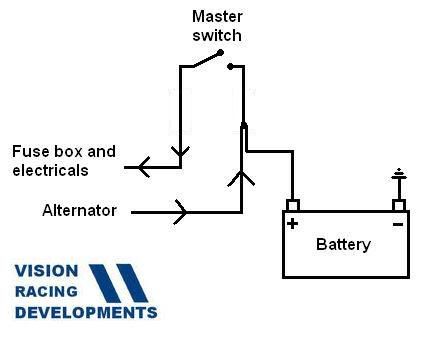
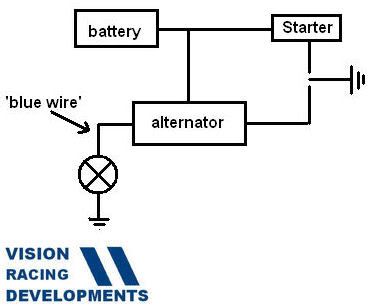
I discussed with a freind mine, about linking the alternator feed, directly to the 'battery' side of the cut out switch. Idea behind it being that the alternator is then completely isolated from the rest of the electrical circuit along with the battery meaning:

A. it cannot gang rape the electronics
B. the engine will stop and not carry on running from the alternator power.

What I want to know is will this work properly? and is there any problem with this and the battery?

This is for a standard cut out switch with out the diode pack.

Diagram:

Image
Last edited by rix313 on Sun Jun 07, 2009 12:18 pm, edited 1 time in total.
User avatar
hoshy
E30 Zone Wiki Guru
E30 Zone Wiki Guru
Posts: 4118
Joined: Tue Jan 18, 2005 11:00 pm
Location: Munich

Sun Jun 07, 2009 12:14 pm

I'm not sure if race regs specifiy a "correct" way to wire in the cut-out switch so perhaps JimmyC or some of the other race guys would know for sure.

Looking at this though I would say it's fine as long as the switch can handle the full-current - I'd be thinkg something >=80-100amps I guess.
E46 M3 CSL but dreaming of another E30.
GeoffBob
Forced Induction Specialist
Posts: 1843
Joined: Tue Apr 28, 2009 11:00 pm

Sun Jun 07, 2009 12:50 pm

Rich, one of the wires amongst the minor gauge wires connected to your alternator is a "voltage sense" wire. This usually connects directly to, or close to, the battery positive terminal. It's job is to "tell" your alternator that it is charging your battery to the correct voltage. (In more detailed terms, it provides voltage feedback to the regulator circuit that controls the current through the alternator field windings). Move this wire across to the otherside of your switch as well, so that when someone pulls your switch your alternator's output current doesn't spike because it thinks your battery has instantly gone flat.

This will work no problem so long as your regs don't declare the possibility of your alternator becoming a hazard if still left connected to the battery after the switch is pulled. Your engine will cut out just fine once the switch is pulled, so personally I don't see any problem. This is exactly how I have mine wired.

BTW Rich, it was you that PM'd me asking me to do a CAD drawing of an alternator plate wasn't it? You're still welcome to send me the scan of your hand drawing if you still want me to draw it up for you (no beer charge, I promise). :D
rix313
E30 Zone Team Member
Posts: 4957
Joined: Fri Oct 31, 2008 11:00 pm
Location: Silverstone
Contact:

Sun Jun 07, 2009 6:38 pm

Oops I totaly forgot about that Geoff sorry :o: The plate is made up and fitted now if you'd like to have a look at my project thread :)

I wasn't aware of this sensory cable. I routed all the cables that were connected to the battery terminal, to the junction box which is connected to the single large cable I have going to the back of the car is this going to be a problem? There was the alternator/starter cable and then two smaller ones crimped into one eyelet which I imagine are for the fuse box? There is a small blue wire also connected to the alternator but I guessed this is for the dash charge warning light? or is it one in the same?

Can you/how do you test the amp rating of the switch using a multi-meter?
GeoffBob
Forced Induction Specialist
Posts: 1843
Joined: Tue Apr 28, 2009 11:00 pm

Sun Jun 07, 2009 9:29 pm

rix313 wrote:Oops I totaly forgot about that Geoff sorry :o: The plate is made up and fitted now if you'd like to have a look at my project thread :)
I saw the plate in your thread but thought you might still want a proper CAD drawing of it for your file. If you still want one, mail me your sketch. Otherwise it's less work for me, so no worries.
rix313 wrote:I wasn't aware of this sensory cable. I routed all the cables that were connected to the battery terminal, to the junction box which is connected to the single large cable I have going to the back of the car is this going to be a problem? There was the alternator/starter cable and then two smaller ones crimped into one eyelet which I imagine are for the fuse box? There is a small blue wire also connected to the alternator but I guessed this is for the dash charge warning light? or is it one in the same?
Yeh, it sounds like that blue wire. I made up my wire loom from wire salvaged from an E36 loom, so my wire colours are all different yours, well actually my alternator is different as well, but they all work pretty much the same. Ideally that wire should be routed to your battery in the back of your car. This is what I did on mine when I shifted the battery to the back. The reason for this is so that your alternator knows exactly what your battery voltage is. If you connect it somewhere else up front, this voltage will be slightly lower depending upon how much current your engine, wipers, lights etc are drawing through the cable that goes back to the battery. The thicker this cable, the lower the volt drop, and the less of a problem it is. You should, however, be aware that when you are pulling a lot of current down that cable your alternators output voltage could push well higher than 14V, so its best to route that "sense" wire straight to the battery. This is how I did mine. The good news though is that the "sense" wire draws very little current, and so can be quite thin.
rix313 wrote:Can you/how do you test the amp rating of the switch using a multi-meter?
Unfortunately this is not possible with a multimeter. Possibly you can trace the part back to the supplier and find out? I don't think you'll draw more than 40A through it with your engine, wipers and lights all on. And I assume you are not carting a boot load if ICE around the track 8) . Do your regs require that you route your starter motor through your switch as well? If this is the case then make sure you have one of the really heavy duty switches as your starter can pull a good 50 to 80A just by itself.
rix313
E30 Zone Team Member
Posts: 4957
Joined: Fri Oct 31, 2008 11:00 pm
Location: Silverstone
Contact:

Sun Jun 07, 2009 10:01 pm

GeoffBob wrote:I saw the plate in your thread but thought you might still want a proper CAD drawing of it for your file. If you still want one, mail me your sketch. Otherwise it's less work for me, so no worries.
Oh ok tah I shall then :) I did a version on paint hope thats ok :o: I can't find it at the mo but will let you know if I find it.


GeoffBob wrote:Yeh, it sounds like that blue wire. I made up my wire loom from wire salvaged from an E36 loom, so my wire colours are all different yours, well actually my alternator is different as well, but they all work pretty much the same. Ideally that wire should be routed to your battery in the back of your car. This is what I did on mine when I shifted the battery to the back. The reason for this is so that your alternator knows exactly what your battery voltage is. If you connect it somewhere else up front, this voltage will be slightly lower depending upon how much current your engine, wipers, lights etc are drawing through the cable that goes back to the battery. The thicker this cable, the lower the volt drop, and the less of a problem it is. You should, however, be aware that when you are pulling a lot of current down that cable your alternators output voltage could push well higher than 14V, so its best to route that "sense" wire straight to the battery. This is how I did mine. The good news though is that the "sense" wire draws very little current, and so can be quite thin.
The battery cable I am using as the main cable is pretty heavy stuff, it's 196/0.40 gauge so hoping the voltage drop will be very minimal through it. The wire I'm proposing to use for the alternator is 126/0.40.


GeoffBob wrote:Unfortunately this is not possible with a multimeter. Possibly you can trace the part back to the supplier and find out? I don't think you'll draw more than 40A through it with your engine, wipers and lights all on. And I assume you are not carting a boot load if ICE around the track 8) . Do your regs require that you route your starter motor through your switch as well? If this is the case then make sure you have one of the really heavy duty switches as your starter can pull a good 50 to 80A just by itself.
It's just a standard battery isolator switch so I guess what ever the run of the mill ones are. There are no regs, its purely a track day toy this car 8) The only reason I'm asking about this is because I have a couple of standard switches kicking about and I can avoid having to faf about with the diode pack ones.

The reason I decided to run the switch is mainly so I can isolate the battery when the car is parked up in the garage so the battery doesn't totaly drain, but also as it's there, have it as an 'if the shit hits the fan' switch.
GeoffBob
Forced Induction Specialist
Posts: 1843
Joined: Tue Apr 28, 2009 11:00 pm

Sun Jun 07, 2009 10:48 pm

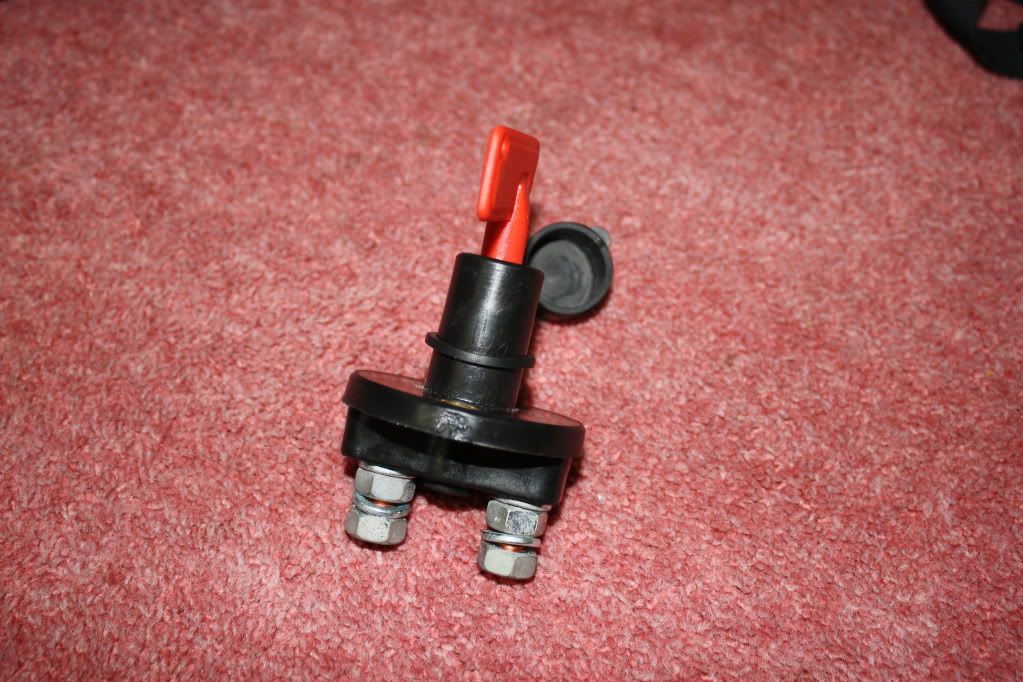
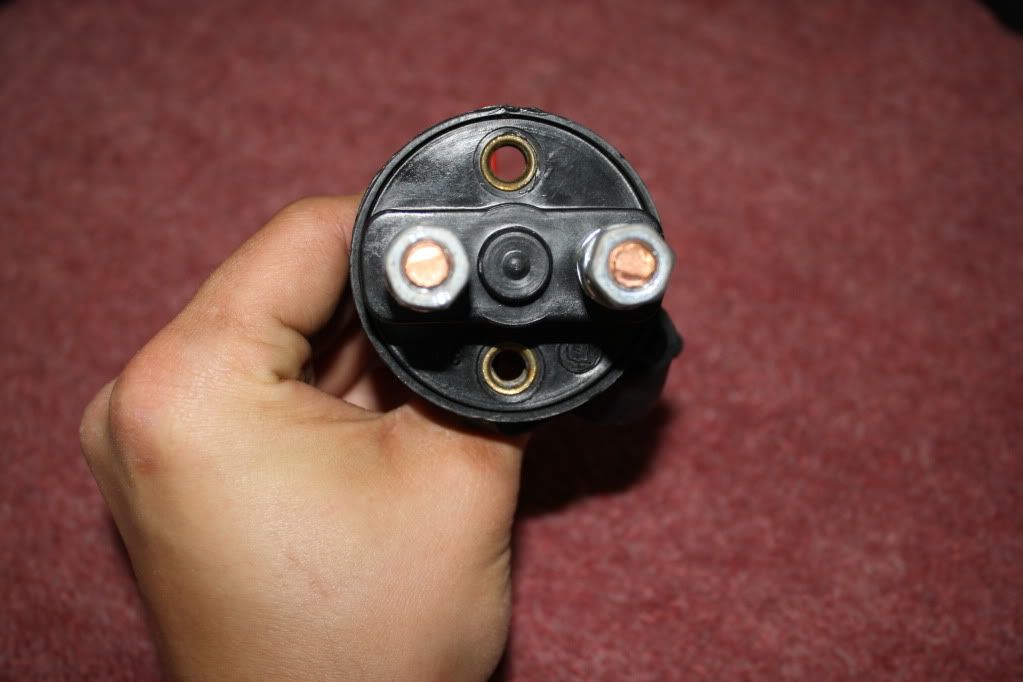
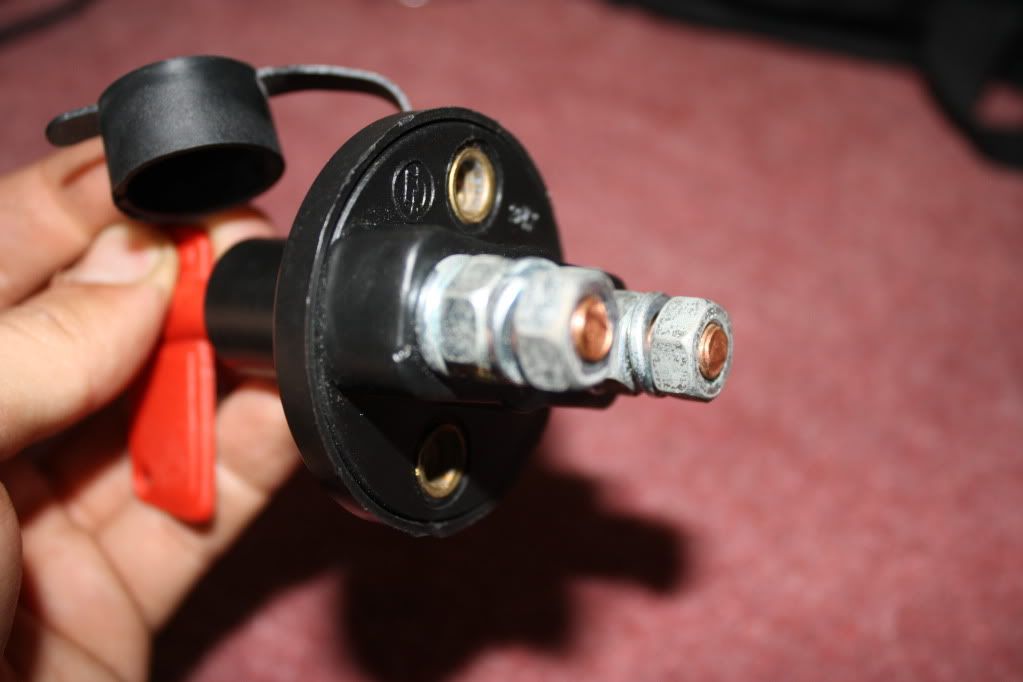
Rich, can you post a pic of that switch? Then at least I can hazard a guess as to its rating.

Regardless of the thickness of the wire, you'll want to move that "sense" wire over to the battery side if you do install that switch. Since it doesn't have to comply with any regs then don't run the starter through it (not sure if you were planning to anyway). This doesn't drain any current while the car is off (or if it does then something is wrong).

To kill your engine all you really need do is to use your switch to isolate the main positive line into the fusebox from your battery. Connect your main altenator wire and "sense" wire to the battery/input side of the switch, and connect the main line to the fuse box to the output side of the switch.

Maybe you can mount the switch below the bottom left edge of the windscreen somewhere?
rix313
E30 Zone Team Member
Posts: 4957
Joined: Fri Oct 31, 2008 11:00 pm
Location: Silverstone
Contact:

Mon Jun 08, 2009 7:24 pm

GeoffBob wrote:Rich, can you post a pic of that switch? Then at least I can hazard a guess as to its rating.
Image

Image

Image

GeoffBob wrote:Regardless of the thickness of the wire, you'll want to move that "sense" wire over to the battery side if you do install that switch. Since it doesn't have to comply with any regs then don't run the starter through it (not sure if you were planning to anyway). This doesn't drain any current while the car is off (or if it does then something is wrong).
Looking at the wiring diagram in the Haynes book of lies, the 'blue wire' is purely for the dash. Also, when I removed the BMW battery clamp, the only cables that were added to it where, the 3 I named above (2 smaller gauge for fuse box and one larger fro the alternator and the starter).

Here's a rough version:

Image


GeoffBob wrote:To kill your engine all you really need do is to use your switch to isolate the main positive line into the fusebox from your battery. Connect your main altenator wire and "sense" wire to the battery/input side of the switch, and connect the main line to the fuse box to the output side of the switch.

Maybe you can mount the switch below the bottom left edge of the windscreen somewhere?
For ease of instalation the switch will be in the cabin will an external pull cable.
GeoffBob
Forced Induction Specialist
Posts: 1843
Joined: Tue Apr 28, 2009 11:00 pm

Tue Jun 09, 2009 12:10 am

Rich,

Your switch looks identical to mine, Should be good for at least 75A I would think.

Sorry about that voltage sense wire, it appears I have sent you on a wild goose hunt. I also checked the Haynes manual and it seems, as you say, the Bosch alternator only has two wires coming out of it, the main charging line and the blue wire to the battery light on the dash (and the body of the alternator is of course connected to chassis). I'm afraid I work on so many different vehicles that I tend to think in generic terms, and there's very few alternators that don't have a voltage sense connection (of course the E30 would happen to be one of them, my luck)

In that case: Alternator and battery before the switch, and main wire into the fuse box after the switch.
rix313
E30 Zone Team Member
Posts: 4957
Joined: Fri Oct 31, 2008 11:00 pm
Location: Silverstone
Contact:

Tue Jun 09, 2009 12:33 am

Awsome thanks for your help :)
User avatar
finite
E30 Zone Newbie
E30 Zone Newbie
Posts: 9
Joined: Sat Jan 31, 2009 11:00 pm

Wed Jun 24, 2009 8:30 pm

Hey Rich - yours is same as mine mate. All fitted now, pop over an take a look.
rix313
E30 Zone Team Member
Posts: 4957
Joined: Fri Oct 31, 2008 11:00 pm
Location: Silverstone
Contact:

Wed Jun 24, 2009 11:11 pm

Fitted it and wired it the other week fella :D Ordered the pull cable so will fit that up soon :)
Post Reply