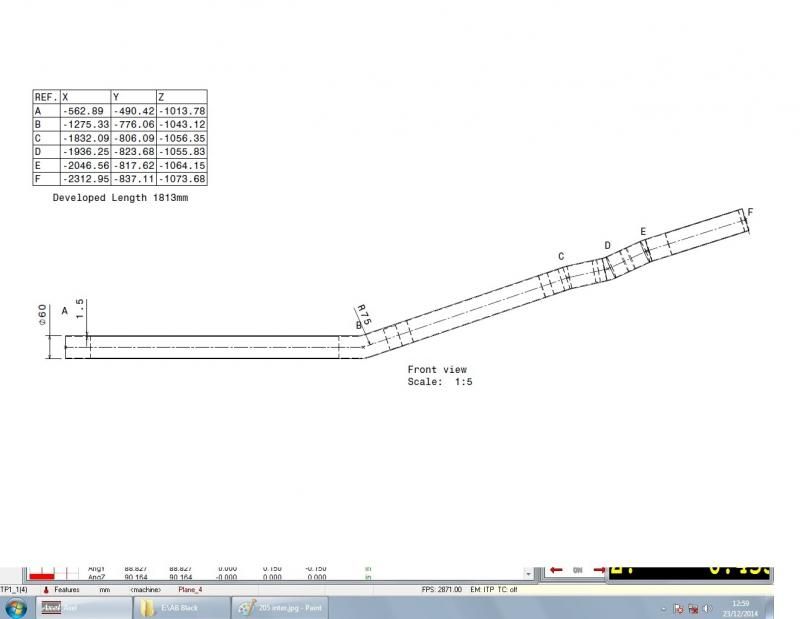
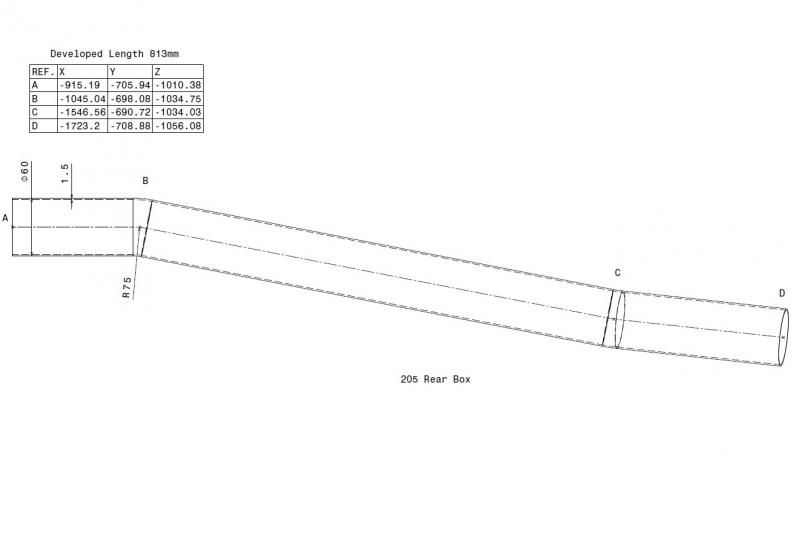
This isn't complete yet(the write up or the actual thing), because I am lazy and when you work with exhausts, yours is always the last in a long line of well paying customers! I have used library photos for now whilst watching a footie match on tv. I will try and replace them with the real thing one day...
Part 1:
Exhausts can be made in a few ways”¦.
CAD it: make a fixture/jig in CAD using cust supplied CAD model of exhaust, produce the fixture and make the exhaust in the fixture.
Reverse Engineer it: Basically starting with someone else’s exhaust. Build a jig around it and re produce the exhaust in the fixture
Guess it?: I think this is how most custom places do it”¦ Bodging stuff on cars basically using off the shelf bends, straights and resonators. It is common to see pressure bent tube and multiple joints. Nasty.
Anyhow, as this is for a sub £4k 205, and I am a tight fucker we are going to mix and mash all three ways together using some of the gear at my disposal at work.
If for any reason you read this lot, you don’t fall asleep, and you can ignore all the lashing up and general bodgery and you decide that JON_BMW could help you lash something onto your E30, please think again! I am too busy to do it, and have no inclination of making my work life any more stressful for a few beer tokens! To give you an idea after all the fannying about and doing sod all it will have probably taken 6-9 months to get it on the car. I don’t want someone (like pony!) phoning me every ten minutes about some bodged up exhaust.
Background:
205 Gti with 16V 1905CC engine (mi16). Circa 160wheel HP. Car requires 4 branch manifold and larger bore exhaust. Currently has ”a8 branch”a standard manifold and circa 2”a pressure bent exhaust system.
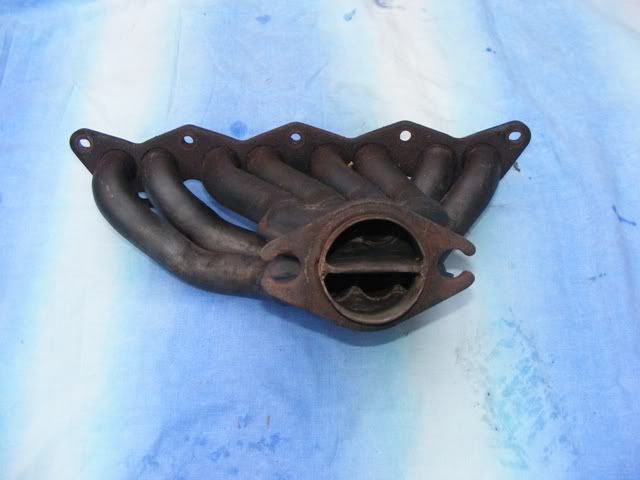
Being tight I found an old manifold on the 205 forum. What a nightmare, even working at my incredibly slow pace it would have been easier making something from scratch. This thing was shite and required hefty rework(read big hammer, air saws and lots of swearing). It came with what can only be described as a JOKE of a collector. This thing had been welded up by someone with even less skills than me. That is saying something!
So fastforward on about 6 months after I bought the manifold it was test fitted onto a cylinder head at work and one of the lads made me a proper 2 into 1 merge collector. This was fully purge welded and is what you need. None of this pressed 2 into 1 collector nonsense. Library pictures attached at the moment!


So to the conundrum, what to do with the scabby ”˜custom’ type exhaust that was on the car?
The routing was essentially good with acceptable clearance. The noise level in the early days was pretty good at around 88DB. The pipework was the usual pressure bent crap that custom places offer. This is for two reasons; ease of work and time. To setup a Mandrel Bender on a different size tube takes anything from 0.5-3hours depending on the machine. To setup some shite Ben Pearmon pressure bender, takes about 5 mins! So when doing custom work, guess which type of bends they offer, most of these places don’t even have a mandrel bender!
The centre resonator (ressy) was borked, with the exhaust wrap(E Glass) overheated and balled in the resonator. Shake the ressy and it would rattle bad. No wonder the car was getting louder and louder at successive track days! It also occasionally spat out of a bit of E glass”¦hmm I wonder why????
The rear resonator must have been made by Stevie wonder. Firstly, the tailpipe”¦OMG what were they thinking, it is about 80mm rolled out. Yikes! Secondly the perforated tube inside the resonator is not in line with the inlet pipe. It is basically eye-lidding and has raw edges all over the shot, something you do not want the exhaust gases hitting. This was also the reason it spat out E Glass once in a while. All very embarrassing, especially when someone, somewhere down the line probably got bent over for £400 for it! Ouch.
The bits I could use then was basically the routing path and the resonator size to hopefully keep under 95DB and that was pretty much it.
So the first thing I did was used our co-ordinate measuring machine (CMM) at work to measure the two exhaust sections I had.
Our CMM is a manual one at work, so requires a reasonable amount of skill and good hand to eye co-ordination to avoid smashing up the £3k probe. Why I am the main user of it in our place”¦god only knows! It basically looks something like this(but manual) with a flat bed on it:

Our CMM is reasonably large because we have to measure exhausts that can be 2500x1200x 800mm in size. Our machine can measure up to 3000 x 1500 x 1500 IIRC.
So you place the exhaust on the table and clamp it in place so that it doesn’t move. You don’t want the part moving whilst you are measuring it, for obvious reason. Then using a probe, like the one below you hit various points on the exhaust to replicate the straights, resonators, inlet and outlet points, hanger brackets etc etc.

The probe is able to move in the ”aA angle”a from straight down to 97.5 degrees. And in ”aB”a it can spin around the whole 360 degrees. This enables you to measure complex parts. You can also change to a smaller or larger styli’ (the red bit at the end) as well as being able to add extensions and other trick bits. For our simple exhaust I could measure pretty much everything with the (0,0) position. That is to say that angle A and B are both at ”azero”a degrees.
The bend software is quite clever, normally you can measure the straights and it will work at the XYZ’s and YBCs of the bends if you can tell it the Centre Line Radius(CLR). As this is pressure bent shit and I am unware of what tooling was used I can’t tell it this. So for the time being all I am interested in doing is measuring straights, resonator boxes, inlet point, outlet point and hanger brackets (basically straights again).
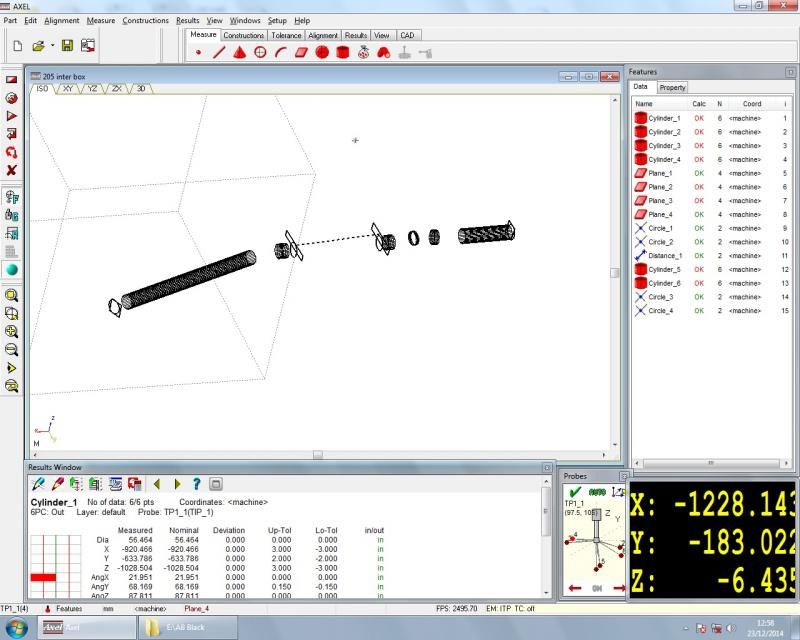
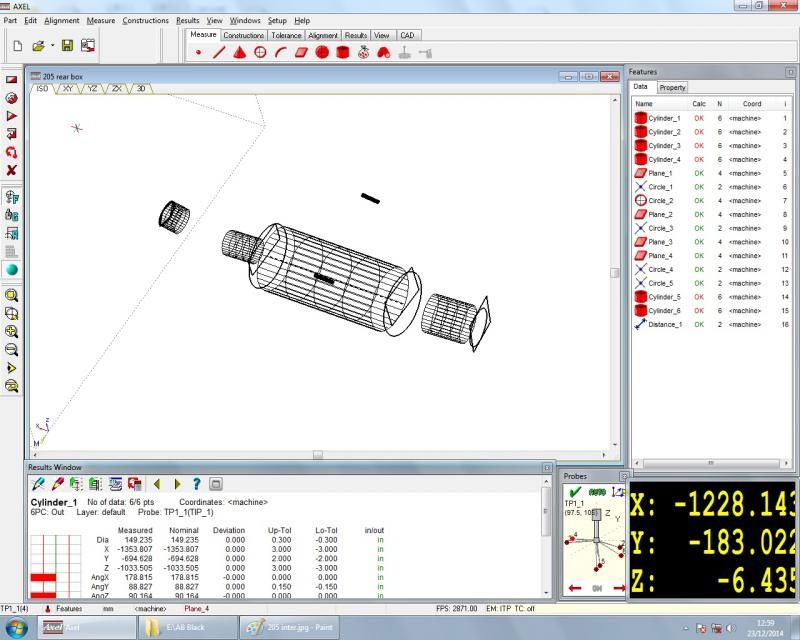
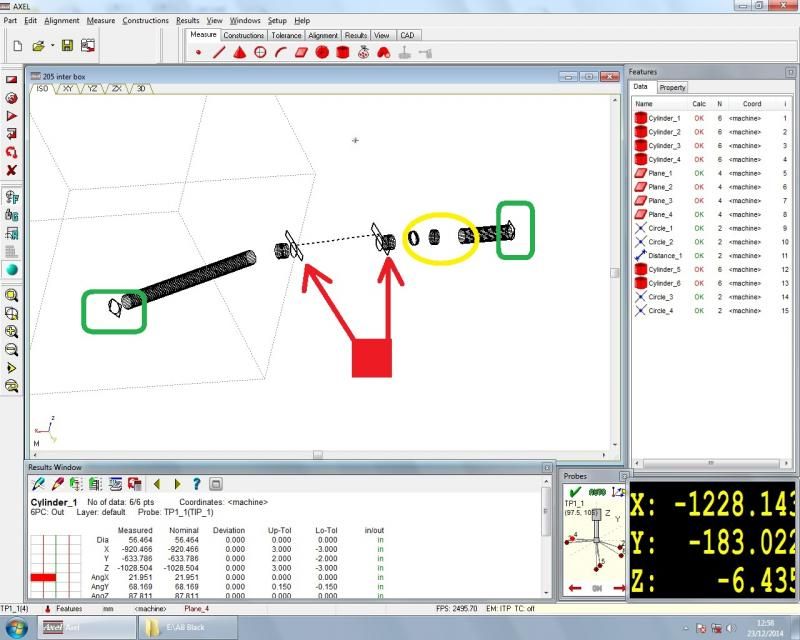
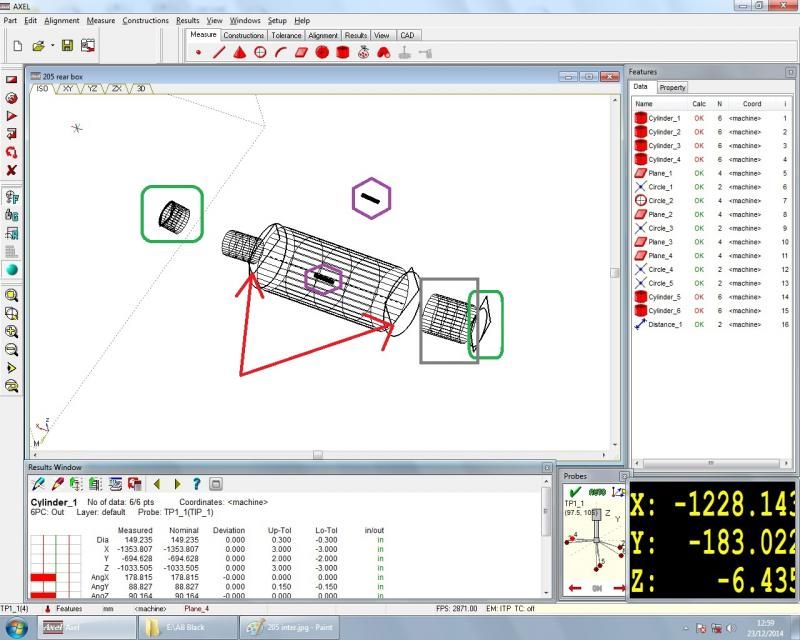
You end up with something like this on screen:
PART 2 to follow when more enthusiasm arrives and I have the screenshot from the machine at work!