Page 1 of 1
Safe rev limit for 731 head?
Posted: Tue Nov 16, 2010 8:04 pm
by DmcL
quick question here.. anyone with a 731 happen to know what the stock redline is and if u really want to help, where any performance chipped cars redline at with a 731.
muchos gracias people

Re: Safe rev limit for 731 head?
Posted: Wed Nov 17, 2010 7:34 pm
by eta
My 520i redlines at 6250rpm (well it will go higher but there is little point).
Posted: Wed Nov 17, 2010 7:42 pm
by StuBeeDoo
It's not really the head that dictates rev-limit - unless you're querying at what point the valves will start to bounce.
My M20B20, which was standard other than having a 325i TB and a wild chip regularly revved past 6.5k with no problems at all. I never did find the rev-limit.
I'd be more concerned about the limitations of the bottom end. Short-stroke engines, such as the M20B20 are far more tolerant of revs than long-stroke motors.
HTH
Stuart.
Re:
Posted: Wed Nov 17, 2010 7:56 pm
by Silverfang
I had one of Speedtouch's Wild chips with an ITG filter and a 6kg flywheel on my old 320i, rev'ed right up to 7k on the RPM gauge on a good few occasions and never had a problem. Would be prudent though to make sure your cambelt's in good condition though.
Re:
Posted: Wed Nov 17, 2010 8:13 pm
by HairyScreech
should be fine to 7000rpm.
the bottom end should be ok as well, i *think* the b27/b28 style bottom end *should* be ok to 8000rpm.
i can say for sure when i get more time to run the numbers.
Re:
Posted: Wed Nov 17, 2010 8:20 pm
by StuBeeDoo
HairyScreech wrote:the bottom end should be ok as well, i *think* the b27/b28 style bottom end *should* be ok to 8000rpm.
Except for the eta, IMHO. I'm on my second one now and I wouldn't be happy revving one much beyond 6k for 2 reasons.
1) There are doubts as to the safe rev-limit of the eta crank. I've seen "talk" of fractured cranks at 6k+.
2) The eta pistons are bloody heavy - mucho reciprocating mass!  Surely if you're wanting a high-revving engine you want the pistons as light as possible.
Re:
Posted: Wed Nov 17, 2010 9:17 pm
by Gunni
I have never EVER heard of fractured bmw cranks EVER.
The ETA reving problem comes from their valve springs.
Re:
Posted: Wed Nov 17, 2010 11:04 pm
by HairyScreech
by b27/b28 style i ment a b25 with 320 rods and b25 pistons.
obviously the rod bolts are a weak point as they are in nearly every engine, so arps or similar are a given.
if someone can give me the weight of the eta piston and gudgeon pin then i can bung it into the spread sheet iv formatted to calculate the reciprocating forces. (god bless formatted spread sheets.

, does allow quick easy number crunching though)
Re:
Posted: Thu Nov 18, 2010 6:28 pm
by DmcL
well the engine is the original lump that was in the car.. the guys in california so compression may be a little lower than our UK/EU models..
its a standard eta engine still with the original 027 motronic 1.0 ECU and with a 323i 731 head/inlet/TB.
im wanting to know how far they will rev before valve float or something breaks, i know they dont have the port size to make any power way high up. i dont plan on setting the rev limit as high as it can go but i want to find out how far it can go so i can look at where power starts to drop off with the 731 and set the limiter slightly above that.
i rev my B25 out to a smidge under 7000 and have done for some time with no issues. power drops off a little before that so id imagine his 731 top end would probably tail off somewhere around where a standard B25's limiter would be, maybe a little below that even.
Re:
Posted: Thu Nov 18, 2010 6:48 pm
by DmcL
maybe its one of the lower comp e/eta pistons that are heavier? there are quite a few variations in B25/B27 pistons tbh.
see here:
http://www.bmwccn.no/rogaland/Mahle_m20.html
no mention of weights on there tho...
Re:
Posted: Thu Nov 18, 2010 8:03 pm
by HairyScreech
the facelift pistons i have here have been weighed in at 540g with pin and rings.
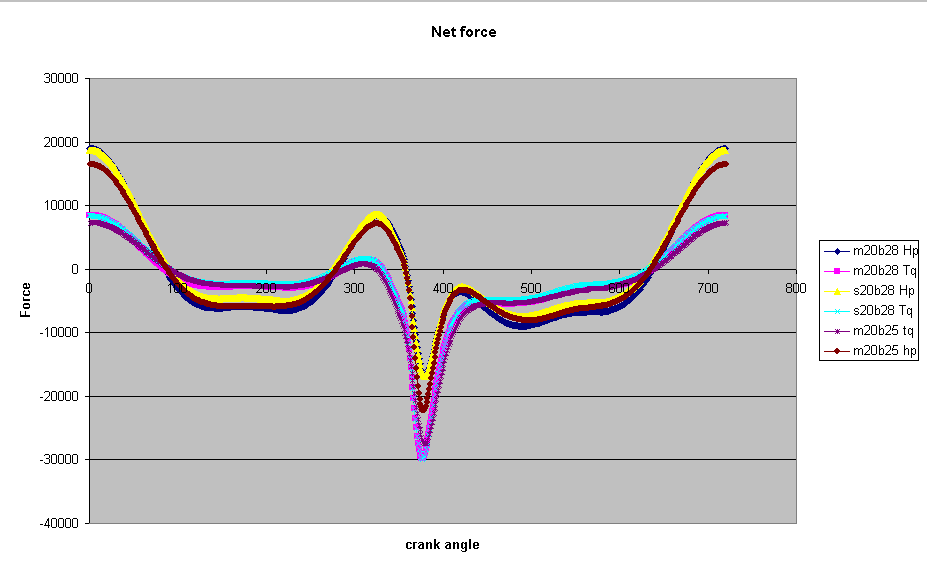
heres the force caused by the reciprocating mass, the rotating mass and the combustion on the shaft of the conrods for a normal b25 a 320 rodded b28 and the one im working on.
hp=6000 rpm
tq=4000 rpm
Re:
Posted: Fri Nov 19, 2010 10:16 pm
by eta
Daimlerman's 2.7 uses an 731 head with 2.5 cam at that got peak power at 5200 rpm. I believe he changed the cam for the one in a 731 head and this shifted his peak power up by 300-500 rpm. So anything beyond 6000 rpm on these engines is pointless.
On mine which a stock eta bottom end with 885 head I get peak power at 5200 rpm and for maximum acceleration my shift point is 5800 rpm. If I hold it any longer I am slower. My acceleration spreadsheet which predicts acceleration based on the RR data I have tells me the same thing, so I can't be imagining it.
Re:
Posted: Fri Dec 10, 2010 10:12 pm
by e301988325i
I'm not sure if this is relevant but March109 ran to 8k on the dyno with an M20 b28 stroker.
Re:
Posted: Sat Dec 11, 2010 6:55 am
by GeoffBob
Gents, aside from the issue of valve-bounce (and irrespective of whether or not the engine is physically strong enough to operate at increased engine speed), the red-line is essentially defined by that point at which the volumetric efficiency of the engine rapidly declines, which is in turn defined by either that point at which the air-flow passed the valves becomes choked, or the pressure at the valve approaches a local minimum as a result of resonance in the intake runners.
Any increase in engine speed beyond that engine speed at which the air-flow becomes choked or diminished will result in a progressive reduction in the mass of air inducted into the cylinder, and hence engine torque (and power) will rapidly diminish, thus defining the engines red-line.
I mention this for two reasons:
1) Arriving at the engines red-line (that point beyond which any further increase in rpm is pointless) does not mean that the engine isn't physically strong enough to rev beyond that point if it had sufficient air to do so.
2) Improving air-flow into the engine (by selectively and intelligently changing/modifying cams, valves, runner length etc.) will raise the engines redline.
”˜Apologies if I have stated the obvious.
Posted: Sat Dec 11, 2010 10:21 am
by StuBeeDoo
^^^^ What you're saying makes total sense.
However, the OP's question was asking the "safe rev limit" for a 731 'head. To me that's asking what revs it will take before damage is caused to it.
Posted: Sat Dec 11, 2010 11:00 am
by GeoffBob
StuBeeDoo wrote:^^^^ What you're saying makes total sense.
However, the OP's question was asking the "safe rev limit" for a 731 'head. To me that's asking what revs it will take before damage is caused to it.
Yes, I understand that. My point is, you can't answer that question on the "stock" engine with 731 head since it'll never rev high enough for you to find out. So far as I am aware (and there's no saying that I am right) the M20 (regardless of head fitted) runs out of puff long before any sign of mechanical failure. They are in fact notorious for their low rpm red-line (imposed by the cams, valves, runners ets). Modification to the exhaust, intakes, cams, valves etc. is required (in which case it is no longer "stock") in order to raise the red-line, in which case it is only then possible to probe the mechanical limitations of the engine. The installation of a "performance chip" only (to which the OP refers) will not achieve this.
Re:
Posted: Sat Dec 11, 2010 10:44 pm
by Gunni
What they mean is, will a M20 stock be able to survive X rpm.
From memory people have noted 7k as the limit but that is not factual, as a 20year old engine has worn rockers, and it´s almost always the rockers that break before anything else.
There is little to no use with more revs on a stock engine as Geoff says, there just isn´t any power there to use.
