Page 1 of 2
Rear brake question/problem
Posted: Wed Feb 03, 2010 7:42 pm
by bumhole
Hi dudes, I decided my brakes were crap and convinced myself I needed a WMS brake kit from keri, after the last track day I did toasted the front pads to the metal. Just finished fitting the splendid kit after bleeding etc... I've got all 4 wheels off the floor and thought I'd just check the power of the standard (old discs) rear brakes. Started the car, let it idle in gear, tried the nice firm brake pedal but they didn't stop the wheels turning! Even pushing as hard as I could on the pedal.
It occured to me it was odd that I changed both front and rear pads at the same time and the trackday only toasted the fronts, the backs still have lots of meat on them.
Could it just be glazed discs? They are very shiny. The callipers are applying pressure as the discs got warm during my testing.
The lines are all new, standard master cylinder, pads standard mintex jobs.
Sick of brakes!!!

Posted: Thu Feb 04, 2010 12:33 am
by keri-WMS
Riiiiiiiight! This sounds very odd to say the least!

So the pedal feels ok, but the rears don't do anything? Do the fronts work?
I haven't messed about with an E30 m-cyl, but is it one of the ones with a "floating" twin-circuit piston thing - and could that be stuck/bottomed out?
I'm off to do some googling to try and find an example of what I mean!
Re:
Posted: Thu Feb 04, 2010 12:39 am
by keri-WMS
You have braided lines from m-cyl to the calipers front and rear don't you?
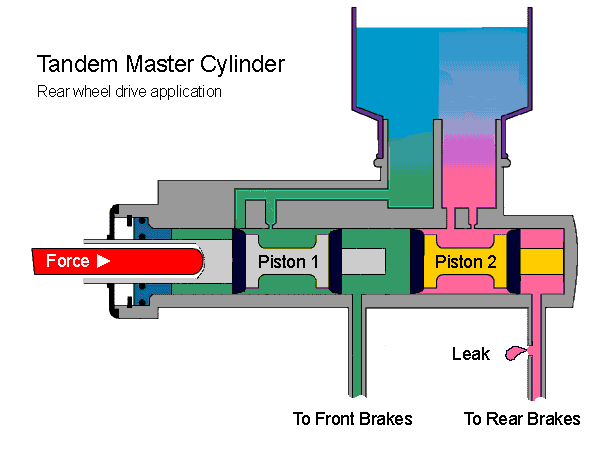
Here's what I meant about two pistons, sort-of:
www.britishv8.org/Articles/Tandem-Master-Cylinders.htm
Re:
Posted: Thu Feb 04, 2010 12:47 am
by gareth
did you bleed all round ok?
if you have continuous braided lines, are they getting trapped / kinked when the car is raised?
Re:
Posted: Thu Feb 04, 2010 12:57 am
by keri-WMS
Am I right in thinking on the E30 that if you have a leak in the rear circuit the fronts will still work? Or is each circuit opposite corners? (front-left and right-rear etc)
I never fully understood HOW the twin circuits are safer - if you undo a bleed nipple (a good simulation of a brake line/caliper seal failure) the pedal still sinks straight to the floor....like when you bleed the brakes by pumping the pedal!

Re:
Posted: Thu Feb 04, 2010 9:21 am
by bumhole
Well that's one thing I've learnt then! I didn't know the mc was arranged like that. I went for a quick drive last night and the brakes seem pretty good, obviously I'm only being gentle because of running new front pads in. So I assume the fronts work fine. Had a check and the lines aren't kinked, can't see any leaks ( line runs through inside of car) the only thing I can think is maybe glazed discs and pads or maybe that little restrictor to the back that I kept in. Something either wrong with it or blocked. Or I suppose the master cylinder could be faulty. Can't see how the restrictor could be blocked if I can bleed them fine.
WMS kit looks ace though !!
Re:
Posted: Thu Feb 04, 2010 1:09 pm
by keri-WMS
bumhole wrote:Well that's one thing I've learnt then! I didn't know the mc was arranged like that. I went for a quick drive last night and the brakes seem pretty good, obviously I'm only being gentle because of running new front pads in. So I assume the fronts work fine. Had a check and the lines aren't kinked, can't see any leaks ( line runs through inside of car) the only thing I can think is maybe glazed discs and pads or maybe that little restrictor to the back that I kept in. Something either wrong with it or blocked. Or I suppose the master cylinder could be faulty. Can't see how the restrictor could be blocked if I can bleed them fine.
So the rear bleeds fine? Ok, that pretty much narrows it down to rear pads, rear caliper pistons, or as you say a dodgey rear bias valve. Has the E30 got a load-sensing rear valve thing (it
was in the air after all)?

bumhole wrote:WMS kit looks ace though !!
Sweet!

Re:
Posted: Thu Feb 04, 2010 2:16 pm
by keri-WMS
GeoffBob wrote:Bumhole, this is not the first time I have seen this question asked, and probably not the last.
I believe that the reason your rear brakes have become ineffective is as a result of fitting the larger front calipers (sorry Keri, no offence intended). What you need to understand is that the amount of force required for the pads to bite into a disc is a function of the caliper piston surface area. The larger the piston area, the less force (as a result of the fuid pressure) is required to brake the rotating wheel. It's the same idea as holding a heavy object firmly in your hand compared to between a finger and thumb. Just a finger and thumb will require a lot more force to hold the object without dropping it. The common or standard way of stating this is to say that a larger caliper provides "increased mechanical advantage".
Now, given that you have increased the size of your front calipers (larger area pistons), it now takes less force on the pedal to make your front brakes bite into the front discs, and hence slow the car down. Problem is, your tandem master cylinder divides the force you apply to the brake pedal between the front and rear fluid circuits and was designed by the OEM to have the front and rear brakes engage more or less simultaneously (slight front advantage actually). What is happening now is that your front brakes are engaging well ahead of your rears, with your rears lagging far behind.
At the extreme of this problem (at such point that the fronts are effectively locked up) you may find that you can't even get the rears to take at all because the fronts prevent you depressing the pedal any further.
Incidentally, this is the reason why many track and race cars employ dual M/C setups, where each M/C is sized individually according to the size caliper it is required to pump fluid to.
The only solutions that come to my mind at this time are that you either need to increase the area of your rear calipers by the same ratio that you increased the fronts, or else look for a tandem M/C from another car that runs a similar disc/caliper arrangement to that which you now have, which will bring your rear brakes "back on line", so to speak.
Er....

WMS E30 4-pot has 4x 1.25" pistons.
E30 OEM is a single 48mm piston on a sliding caliper (doubles the effective area of the piston).
If you run the numbers you'll find the piston area isn't what you assumed!
Cheers,
Keri
Re:
Posted: Thu Feb 04, 2010 2:39 pm
by GeoffBob
Fair enough Keri. Had already realised and deleted the post before you replied, but you were obviously already in the process of reply.
With 4x1.25" pistons I would not expect to see what the OP has described (not enough of a difference from the original caliper) - so please ignore my post (that never was
). Sometimes I type faster than I think (and I don't type very fast

).
Bumhole, there is a very nice explanation of how a tandem M/C works
here
Re:
Posted: Thu Feb 04, 2010 2:50 pm
by keri-WMS
GeoffBob wrote:Fair enough Keri. Had already realised and deleted the post before you replied, but you were obviously already in the process of reply.
With 4x1.25" pistons I would not expect to see what the OP has described (not enough of a difference from the original caliper) - so please ignore my post (that never was
). Sometimes I type faster than I think (and I don't type very fast
).
Bumhole, there is a very nice explanation of how a tandem M/C works
here
No problemo!
You are of course completely right that "average" 4-pots will have more area than the WMS ones, and mess with the E30 bias as a result - I'll leave the quote there if it's ok as it's a handy reference for anyone with missmatched 4-pots who might be having this kind of problem?
Re:
Posted: Thu Feb 04, 2010 3:09 pm
by GeoffBob
keri-WMS wrote:No problemo!
You are of course completely right that "average" 4-pots will have more area than the WMS ones, and mess with the E30 bias as a result - I'll leave the quote there if it's ok as it's a handy reference for anyone with missmatched 4-pots who might be having this kind of problem?
With pleasure. Wouldn't be the first time I have seen someone with incorrectly sized calipers (and resultant bias problems), but I was clearly mistaken in thinking this was the case with the product you offer.
Bumhole, I would suggest that you check your proportioning valve (in the rear hydraulic line) as you already stated. It is indeed possible that it has gone faulty such that it allows sufficient fluid to flow through the restriction while bleeding at low pressure (making all appear normal), but severely limits the fluid pressure to the rear brakes at higher line pressure.
Re:
Posted: Thu Feb 04, 2010 3:34 pm
by keri-WMS
Can someone confirm if the E30 has a ride height (load) sensing rear proportioning valve? If it seems to be ok when driven (ie it's on the ground) but reduces rear braking when jacked up could it be maladjusted, or even working as it should but beyond it's intended suspension travel?
As Geoffbob said, it could also simply be knackered!
Re:
Posted: Thu Feb 04, 2010 4:32 pm
by bumhole
I don't think there is a load valve, only seen one of them on a peugot of a friends. It was a clunky looking spring device. I freed it off for him with a hammer and WD.
I'll reluctantly take the bias valve off, it's going to be a right game as the flexi hose joints don't swivel that I used, and I'll have to replace the olives. What do you reckon, throw it away? Drill a bigger hole in it?
Thanks for the help
I really wish I hadn't done my name as bumhole now!
Re:
Posted: Thu Feb 04, 2010 4:57 pm
by e301988325i
No load sensing valve on mine. There doesn't need to be on RWD vehicles as there is sufficient weight on the rear wheels at all times, unlike a FWD hatch, to keep the rear tyres engaged.
Recently 'Daimlerman' had very similar syptoms to you bumhole, try searching for the thread.
Geoff, I was concerned when I fitted my wilwoods up front that the rears would engage before the fronts because of the extra fluid that has to be displaced in the front calipers. . . Incidentally I upgraded the rear calipers shortly after to E30 M3 spec and I feel the balance has been kept.
MOT test says 53% front 47% rear brake force distrubution, the tail will wag when I really stand on the brakes!!!
Re:
Posted: Thu Feb 04, 2010 5:01 pm
by keri-WMS
bumhole wrote:I don't think there is a load valve, only seen one of them on a peugot of a friends. It was a clunky looking spring device. I freed it off for him with a hammer and WD.
That was where I first saw one, when I was looking at Gareth's old 205 1.9Gti.
bumhole wrote:I'll reluctantly take the bias valve off, it's going to be a right game as the flexi hose joints don't swivel that I used, and I'll have to replace the olives. What do you reckon, throw it away? Drill a bigger hole in it?
Thanks for the help
I'll have to defer to the OEM part gurus as regards the actual valve....but I wouldn't modifiy it, just service it etc.
bumhole wrote:I really wish I hadn't done my name as bumhole now!
Made me laugh when I first got a PM off you I must admit!

Re:
Posted: Thu Feb 04, 2010 6:08 pm
by bumhole
Cool, found that thread thanks. Must be a problem affecting us Lincoln folk! I'm going to drill it I reckon. Simon says in the last post that's what alpina did. It is an incredibly tiny hole. What's the worst that can happen appart from crashing and dying of course.
Re:
Posted: Thu Feb 04, 2010 8:12 pm
by bumhole
mmmnnnn done the bodge/mod. I took bias valve out and seperated it.
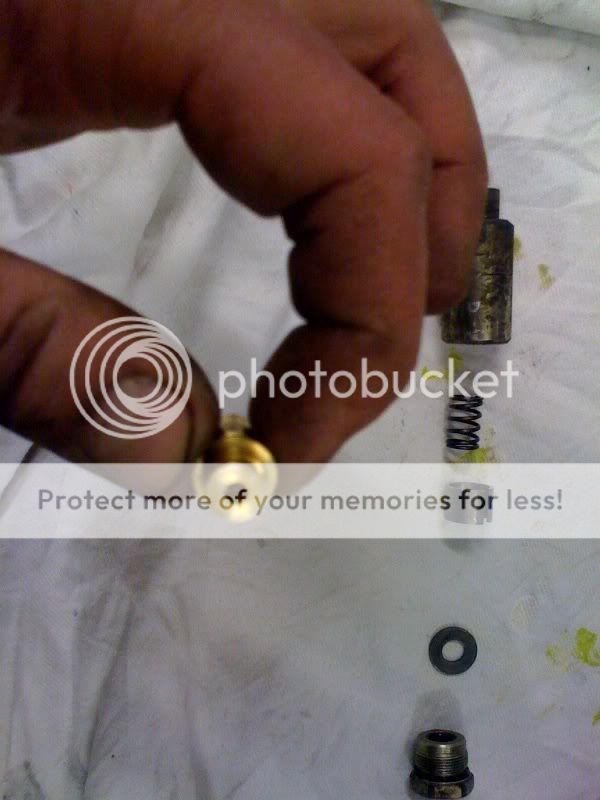
Then I drilled a 2.5MM hole in the brass bit.
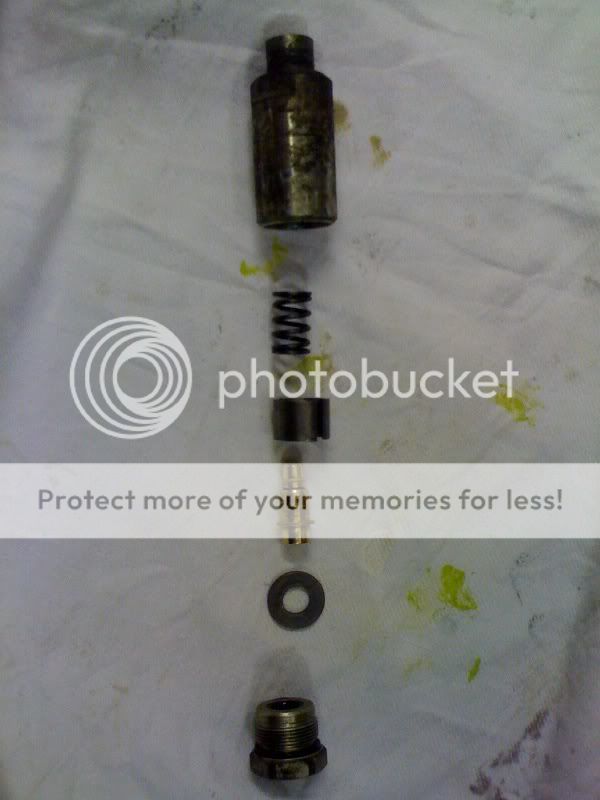
Put it back together and tried it again, and they still wont stall the engine in 1st gear.
They will now in 2nd gear and they do seem a bit more powerful.
I drove the wheels for about 20-30 seconds with the brakes on and the discs got so hot i couldnt touch them. must be knackered discs and pads????
Re:
Posted: Thu Feb 04, 2010 8:29 pm
by psychochild187
nothing to do with abs is it?
Re:
Posted: Thu Feb 04, 2010 8:33 pm
by bumhole
no, i ripped it out, it didn't work anyway! haha
Re:
Posted: Thu Feb 04, 2010 9:30 pm
by GeoffBob
bumhole wrote:They will now in 2nd gear and they do seem a bit more powerful.
I drove the wheels for about 20-30 seconds with the brakes on and the discs got so hot i couldnt touch them. must be knackered discs and pads????
Take the valve apart again and re-assemble with the internals omitted such the fluid can pass straight through. The fact that the brakes are getting hot tells you that the caliper is biting down (and thus doing work which = heat) , but not biting down hard enough due to low fluid pressure at the calipers.
Your pressure regulating valve works such that when the line pressure (from the M/C) is high enough it forces the valve closed (working against the action of the spring), thus limiting the fluid pressure to the calipers. Your valve is clearly faulty. Unless you have severely glazed your rear pads (as a result of over-heating), thus reducing the coeffcient of friction of the pads, I would expect your engine to stall at idle in 1st gear when you apply the brakes.
If the brakes work fine with the internals omitted I would then consider fitting a new (working) valve else you risk the rear locking up under heavy braking.
Re:
Posted: Thu Feb 04, 2010 9:46 pm
by GeoffBob
e301988325i wrote:Geoff, I was concerned when I fitted my wilwoods up front that the rears would engage before the fronts because of the extra fluid that has to be displaced in the front calipers. . . Incidentally I upgraded the rear calipers shortly after to E30 M3 spec and I feel the balance has been kept.
Interestingly, it's not so much a case of how much fluid you have to
displace, but the force that is required to
compress (to the required pressure) the fluid filling the space between (and in) the M/C and the caliper. Keep in mind that hydraulic fluid (unlike water BTW) is compressible. The travel of the pedal that you feel as you push your foot down isn't fluid being pumped into the caliper, its the fluid that is already there being
compressed.
A caliper with large pistons will require less hydraulic pressure to produce the same braking torque as a caliper with small pistons (assuming pads of the same friction material). And this actually requires less pedal travel in order to exert this lesser pressure upon the larger surface area piston.
Re:
Posted: Thu Feb 04, 2010 10:06 pm
by bumhole
Right, thanks for the advice. I'll give it a go tomorrow night and post up how I get on thanks
Re:
Posted: Fri Feb 05, 2010 11:06 pm
by bumhole
Tonight (just finished
) Took apart the bias valve like Geoffbob said and put it back together minus internal bits. Made a smidge of difference, it seemed slightly harder for the engine to keep the wheels turning. Today I bought some new discs and already had some new ferrodo pads. I put them on next and they seem to have made it again, slightly harder for the engine to keep the wheels turning but still they wont stall it. The handbrake will though! bonus! Possibility that new discs and pads need bedding in before they will bite.
Any other ideas very much appreciated. What if the spacer I made for the master cylinder (with clio servo) was too short? What are the chances of the master cylinder being shafted?
Re:
Posted: Sat Feb 06, 2010 4:37 pm
by Chris
Just to check.
The slide bolts on the rear calipers haven't siezed up have they?
Chris
Re:
Posted: Sat Feb 06, 2010 5:14 pm
by GeoffBob
bumhole wrote:Tonight (just finished
) Took apart the bias valve like Geoffbob said and put it back together minus internal bits. Made a smidge of difference, it seemed slightly harder for the engine to keep the wheels turning. Today I bought some new discs and already had some new ferrodo pads. I put them on next and they seem to have made it again, slightly harder for the engine to keep the wheels turning but still they wont stall it. The handbrake will though! bonus! Possibility that new discs and pads need bedding in before they will bite.
Any other ideas very much appreciated. What if the spacer I made for the master cylinder (with clio servo) was too short? What are the chances of the master cylinder being shafted?
OK, the fact that you still aren't getting enough fluid pressure to the rear callipers (with the valve internals omitted) tells us that your valve is not to blame for any of this. Likewise, the fact that you can stall the engine by pulling up the handbrake tells me that the problem is not your pads or discs. Yes, I realise that the shoes are separate from the pads, but if a new pair of shoes can brake the wheel, then a new pair of pads most certainly will too (regardless of whether they are bedded in or not).
Your problem then, most undoubtedly, lies with either your M/C or the braided lines that you have installed. From your above posts I think you have already ruled our your new hydraulic lines and thus I would suggest that the operation of the rear fluid circuit of your M/C is questionable. I wasn't aware, TBH, that you were using a Clio servo. However, if your M/C is able to deliver sufficient fluid pressure to operate your front callipers, then I would expect the rear pressure to be similar (assuming the M/C is working as it should). What I am saying here is that if your front brakes are working, then your spacer is correct. The reason I say this is because of the way a Tandem M/C works (see that link I posted in one of my earlier posts - click on the arrows in the diagrams to animate them). In short, provided the centre piston is free-floating (not jammed or seized) the fluid pressure in your front and rear hydraulic circuits
should be identical (assuming the primary and secondary sections of the tandem M/C have the same diameter).
So what does all this mean? It means that:
a) if your spacer is too short (and your M/C is in good health) then
both your front
and rear line pressure could be too low!! or,
b) Your spacer is correct but the M/C is faulty.
These suggestions assume, however, that you have already thoroughly ruled out the possibility of blocked or leaking fluid lines, jammed calipers,
and that your rear hydraulic line has been correctly bled.
One way to diagnose your problem further would be to disconnect each of the lines, one at a time, and temporarily attach a pressure gauge (with bleed nipple). You'll find such a thing available from specialist hydraulic shops.
Re:
Posted: Sat Feb 06, 2010 7:36 pm
by daimlerman
I have a standard brake setup and have been talking to the OP via PM,as I had missed this thread!
I too have had a similar problem following an M50 conversion using a clio servo.
Danthe told me(several times
) that the correct length for a spacer was 8-10mm,despite my measurements matching the op's at around the 25mm mark.
I am now on my 4th master cylinder,OK,the first was twenty years old,second from GSF was swapped under warranty for the third,which I replaced just before Christmas.
My theory is that a too long spacer allows the front brakes to be applied but not the rears...
But I also have working ABS(I know it works because there has been a fair amount of ice on the roads I use

)and I found air trapped in the ABS pump.
So a combination of replacement master and being very careful with bleeding is working for me,so far...
Re:
Posted: Sat Feb 06, 2010 8:32 pm
by bumhole
The only thing I don't understand about having too long a spacer is that surely the brakes would be permanently on? In fact I just don't understand! Thanks for the comprehensive replies. I guess the m/c is jiggered whatever so I need a new one. So, should there be a gap between the end of the servo rod and the bit it pushes on in the m/c?
Re:
Posted: Sat Feb 06, 2010 8:39 pm
by bumhole
I was thinking that if I pulled one of the front brake lines off the m/c and plug the rear in it's place.??
Might that work as a diagnosis?
Re:
Posted: Sat Feb 06, 2010 8:40 pm
by daimlerman
This is what I discovered one day in the middle of the city!
Brakes locked on solid on Broadgate.....
I slacked off the master cylinder mount nuts until I heard the brakes release...
Bear in mind I also,at the same time,converted LHD to RHD so I am still unconvinced that I have the brake link rod correctly adjusted!
But afterall,the thing did pass it's MoT this week,so the brakes must be right at the moment.
Just struggling with the driver's door lock...
Bloody cars...
Re:
Posted: Sat Feb 06, 2010 10:34 pm
by DanThe
More like 20 - 22mm long Malcolm! I wouldnt have said 8 or 10
Sounds to me like the spacer is wrong
Re:
Posted: Sat Feb 06, 2010 10:38 pm
by DanThe
If the spacer is too long the front brakes will lock up after driving for a while, not straight away, I assume because the fluid is not allowed to return through the MC freely. If the fronts are locked up you wont be able to apply pressure to the rears
Re:
Posted: Sun Feb 07, 2010 6:52 am
by GeoffBob
bumhole wrote:I was thinking that if I pulled one of the front brake lines off the m/c and plug the rear in it's place.??
Might that work as a diagnosis?
Yes, I think this would be informative. Keep in mind, however, that your
front brake circuit would now be supplying one front and two rear callipers, so this is for test purposes only. If you drain the
rear fluid circuit of your tandem M/C (in order to conduct this test) then the pedal will drop rapidly when you depress it until the secondary piston inside the M/C halts on its stops, at which time you will be able to pressurise the front brake circuit (now with rear callipers connected) as the pedal pumps the fluid in the chamber between the primary and secondary pistons. This assumes that the pedal doesn't bottom out on the bulkhead first (see that animation I keep banging on about
here )
Just to confirm, your M/C typically has the two front lines connected roughly half-way along its length, and the rear connects to the outlet on its end?
Also, anyone know the diameter of the primary and secondary fluid chambers inside the M/C? If memory serves, the rear brake circuit has a chamber of lesser diameter than the front brake circuit (as is the typical method of establishing the required brake bias on a vehicle using a tandem M/C). Or is it one diameter the whole way through?
Finally, if your spacer is too long then it is possible that the M/C primary piston (connected to the pedal via the spacer) is not releasing all the way back along the M/C when you take your foot off the brake pedal. In which case it is highly likely that the secondary piston is not falling back far enough to allow fresh fluid to be drawn into the secondary chamber via the fluid intake holes. This would certainly account for a reduction in pressure on the rear brake circuit!
Re:
Posted: Sun Feb 07, 2010 11:37 am
by daimlerman
DanThe wrote:More like 20 - 22mm long Malcolm! I wouldnt have said 8 or 10
Sounds to me like the spacer is wrong
Oh bugger!Sorry Dan...

it's me age...
That must be why my pedal is still a little 'long'....
Re:
Posted: Sun Feb 07, 2010 11:48 am
by 12345kevin
daimlerman wrote:DanThe wrote:More like 20 - 22mm long Malcolm! I wouldnt have said 8 or 10
Sounds to me like the spacer is wrong
Oh bugger!Sorry Dan...
it's me age...
That must be why my pedal is still a little 'long'....
Mine is about 10mm for the "golf" servo, seems to work OK. When I started it was a few mm longer and ended up with locked brakes about 5 miles from home with no tools on a test drive !!
Re:
Posted: Sun Feb 07, 2010 7:21 pm
by bumhole
Had another quick look at this problem again today. I took the master cylinder off the servo, I planned to check the spacer length. It turns out I can't get the little git out, however, I remeasured the rod to front face of servo and it's 25mm. The spacer was made a bit smaller than that if my memory serves me. Also when fitting the m/c back on the servo it does not push on the servo rod. So the spacer is certainly not causing the brakes to be on all the time. I assume the m/c pistons have seals around them? so what I am pressuming is that the rear piston seal is leaking slightly. Looking at geoffbob's animation it seems feasible for that to be the case???
 it's me age...